改裝 2080 Ti 22G · part 12
[Just for Fun — Advanced] Why Isn't Your 4-Bit Quant Faster on a 2080 Ti? I Tore Open the CUDA Backend to Find Out
❯ cat --toc
- Intro
- Turing Has No Instruction for 4-Bit Times 16-Bit
- So GGUF, AWQ, GPTQ, and Marlin All Take the Same Detour
- The Proof: a Smaller Quant Format Ran Slower
- The One Native 4-Bit Path Is Broken by Design
- What to Actually Run
- Deep dive: the W4A8 case file
- Reading 36% fewer weight bytes — why didn't I get a single second back?
- The banner prints `asym_w4a8_int8` — so why is it slow?
- Is the guard hiding missing software, or missing hardware?
- Two landmines I stepped on along the way
- What my July selection matrix got wrong — and what it still got right
- A signal worth waiting for
TL;DR
Quantizing to 4-bit doesn't make a 2080 Ti faster — it only makes the file smaller. Dumping the CUDA backend's .so with nm -D shows why: Turing has kernels for s4×s4 and s8×s8, but none for s4×s8 or s4×f16. Every 4-bit format — GGUF, AWQ, GPTQ, Marlin — dequantizes weights back to fp16 before the GEMM, because that mixed-width instruction doesn't exist. Proof it's compute-bound, not bandwidth-bound: W4A8's 12.54GB (36% less than INT8's 19.53GB) still measured 454s against INT8's 239s. The only natively accelerated quant on this card is W8A8-INT8, and even that needs a quality check first — Wan 2.2's LowNoise DiT under W8A8 dropped to visible noise.

Intro
Repacking a truckload of cargo from big boxes into small ones saves warehouse rent. It doesn't save labor — the movers still unpack every small box back into a big one before they carry it. You paid to shrink the boxes, and the carrying cost didn't move.
That's the trap in this article. You quantize a model. The file drops to half its size, but tok/s doesn't change. Sometimes it gets worse.
This is part 12 of the modded 2080 Ti series, picking up right where #11 left off. That one got MiniMax-H3 running on this card with INT8 and ruled out W4A4 on quality grounds — but it left one question unanswered: why is there nothing between them, no way to keep 4-bit weights without sacrificing quality? This article follows that question all the way down to the instruction level.
Turing Has No Instruction for 4-Bit Times 16-Bit
I dumped comfy-kitchen's CUDA backend, _C.abi3.so, with nm -D and c++filt, then classified every symbol by cutlass::arch::SmXX and by operand width. Look at the last two columns — they're empty on every architecture:
| Arch | s4×s4 | s8×s8 | s4×s8 | s4×f16 |
|---|---|---|---|---|
| Sm75 (Turing, this card) | 32 symbols/dtype | 64 symbols/dtype | — | — |
| Sm80 (Ampere) | — | 96 symbols/dtype | — | — |
| Sm89 (Ada) | 56 symbols/dtype | — | — | — |
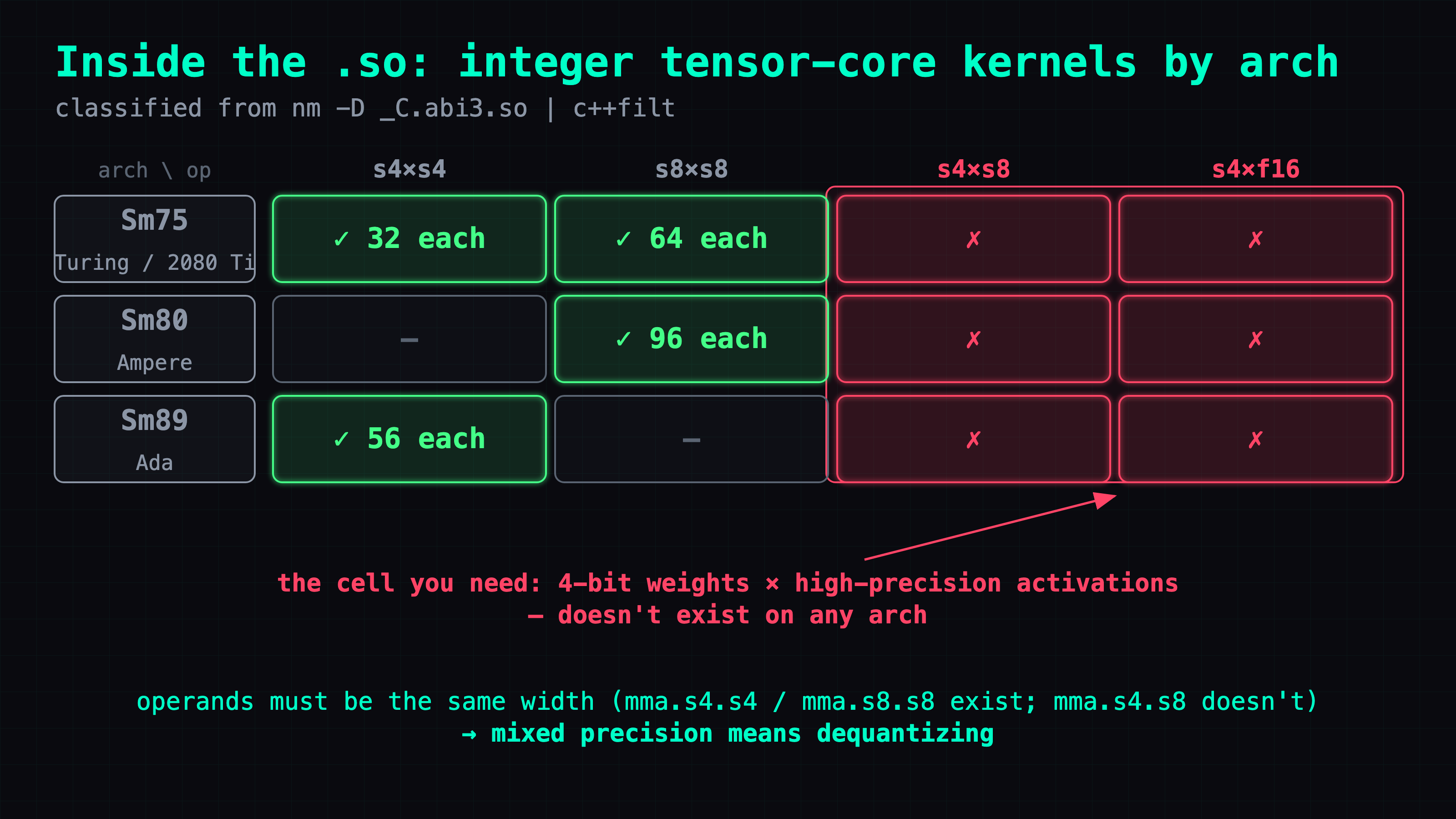
The hardware instructions mma.s4.s4 and mma.s8.s8 exist. mma.s4.s8 does not. Both operands to a tensor core matrix multiply have to be the same width — you can't multiply a 4-bit weight against a 16-bit activation in one instruction, on any of these three architectures. This isn't a software gap. The instruction simply doesn't exist.
So GGUF, AWQ, GPTQ, and Marlin All Take the Same Detour
Every 4-bit format on the market routes around the missing instruction the same way: dequantize the 4-bit weights back to fp16, once per layer, then run an ordinary fp16 GEMM.
The TurboMind paper (arXiv 2508.15601v2) spells out the sequence for its own INT4 path: load the INT4 weights, convert with I2F, dequantize to FP16, then run the FP16 tensor core GEMM. That's the same dequant-to-fp16 principle GGUF's Q4 kernels use.
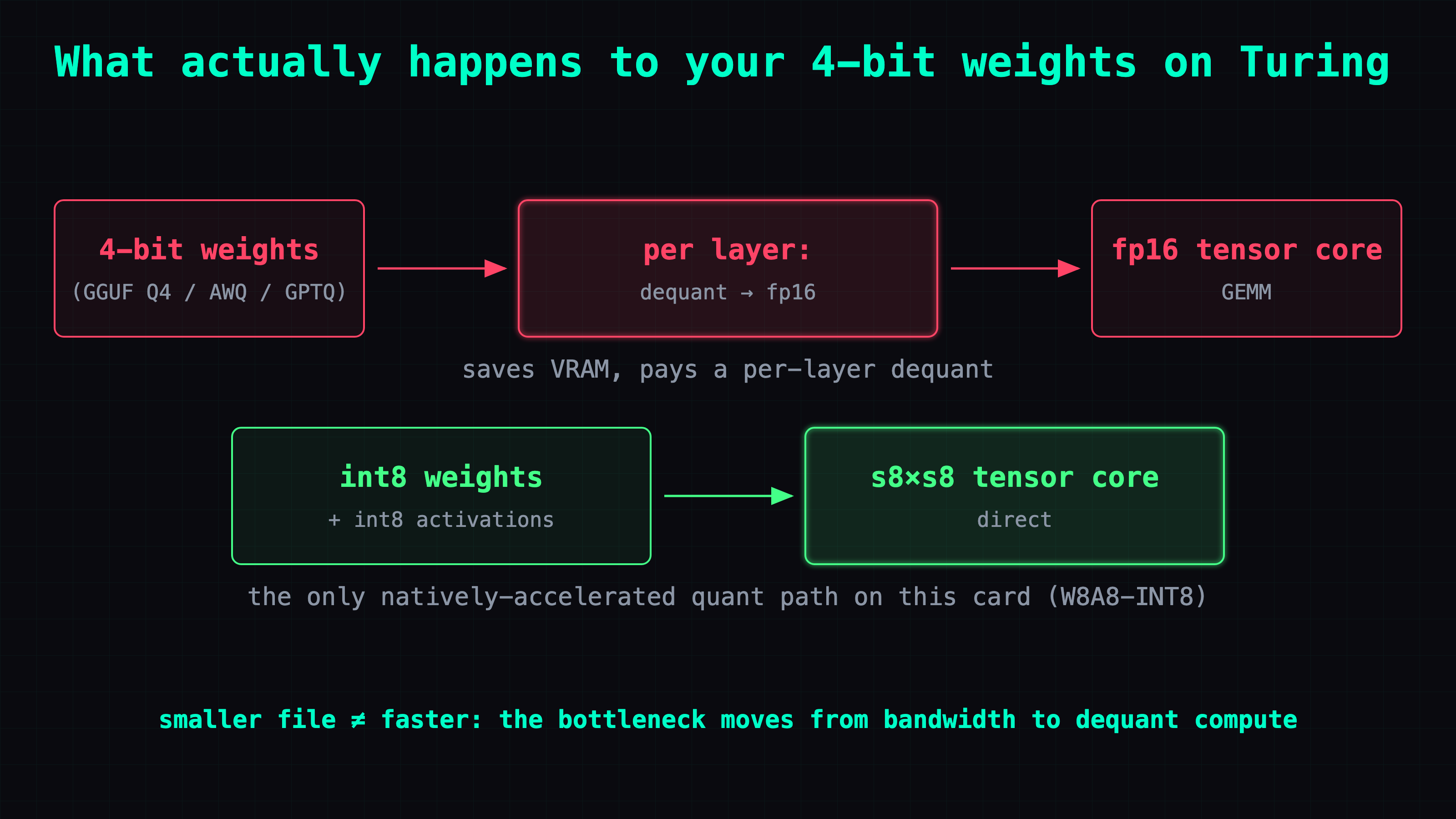
Quantization on this card buys VRAM headroom. It does not buy time.
The Proof: a Smaller Quant Format Ran Slower
If the win were bandwidth, a smaller file should always be faster. IQ3_M is smaller and more aggressive than Q4_K, and it measured slower on all three workloads:
| Workload | Q4_K | IQ3_M | Change |
|---|---|---|---|
| struct | 45.9 tok/s | 37.1 tok/s | −19% |
| reasoning | 45.3 tok/s | 39.9 tok/s | −12% |
| create | 29.3 tok/s | 28.6 tok/s | −3% |
Q4_K's dequant is a linear block multiply-add. IQ3_M's is a nonlinear codebook lookup — much heavier per weight. That moves the bottleneck from VRAM bandwidth to dequant compute. "Smaller file means faster" needs two things to hold: the workload has to be genuinely bandwidth-bound, and the dequant has to be cheap. Turing fails both.
The One Native 4-Bit Path Is Broken by Design
W4A4 — 4-bit weights and 4-bit activations — does have a native instruction. At the kernel level it's fast: blocks.0.attn.out_proj went from 19.256ms in eager mode to 1.373ms in CUDA, a 14.02× speedup, and the biggest matrix in the model, which OOMs in eager, completes in 3.063ms under W4A4. Caveat: that was measured on a nearly-full GPU and may be inflated. End to end, across a full fp32 pipeline, it only bought 6.3%.
Quality is what kills it. Relative error is 0.0110 for INT8 versus 0.2005 for W4A4 — 18× worse. The full autopsy, including the color tearing it produced on a video model, lives in #11's "Why W4A4 doesn't work" section.
So this card has exactly two rungs on the quantization ladder: W4A4, native but broken, and INT8, native and fine. There's no middle band.
What to Actually Run
This table covers the decision; the row underneath is the part people skip.
| Situation | Use | Why |
|---|---|---|
| Model doesn't fit in VRAM | GGUF Q4 | It runs — don't expect the dequant to be free |
| Fits, and you want speed | W8A8-INT8 | Only natively accelerated quant path: 2.07–2.83× vs FP16, measured on Wan FFN shapes |
| NVFP4 / FP8 | Skip | Emulated here — GGUF Q4_K_M ran 53.083s vs NVFP4's 142.434s (video-gen benchmark), GGUF 2.68× faster |
| Quality doesn't matter | W4A4 | Fast but 18× the error of INT8 |
INT8 isn't a free pass either. Wan 2.2's LowNoise DiT under W8A8 dropped to SSIM 0.345642 — visible confetti noise in the output. Always eyeball a quality A/B before you ship a quant, even the one with a real hardware path.
Quantization on this card still saves the rent. The labor bill doesn't shrink.
Deep dive: the W4A8 case file
Reading this section is optional. It doesn't change what to run — that's already decided above. It's the investigation that got me there, including a hypothesis I killed with my own measurement and a claim from July I had to walk back.
Reading 36% fewer weight bytes — why didn't I get a single second back?
comfy-kitchen's W4A8 path — 4-bit weights, 8-bit activations — ships with a claim from its author of roughly 1.09× INT8's speed. My expectation: W4A8's weights come to 12.54GB against INT8's 19.53GB, 36% less to read per step. Under fixed memory bandwidth, that alone should win.
I measured both on the same H3 DiT from #11, under identical conditions: 864×480, 124 frames, 14 steps, Spectrum on, seed 42.
| Format | Time | Residency |
|---|---|---|
| INT8 | 238.55s | loaded partially, 778.39MB offloaded |
| W4A8 | 454.19s | loaded completely, zero offload |
W4A8 was 90% slower with a fully resident model and zero offload — the best-case residency scenario. If it were bandwidth-bound, that's exactly backwards. The slowness is compute, not memory traffic, which means tuning --reserve-vram for this comparison is pointless. My own experiment killed my own hypothesis.
A related datapoint, with an explicit caveat attached: on the H3 video DiT (2026-08-05, same box), a fully resident Q3 GGUF took 189.23s against an offloaded INT8's 110s — 72% slower. But the two arms there differ in more than quantization (Q3_K_M vs INT8-ConvRot, different residency), so on its own it only proves that a fully-resident GGUF still loses to an offloaded INT8. The W4A8-vs-INT8 pair above is the clean isolation.
The banner prints asym_w4a8_int8 — so why is it slow?
First suspicion: maybe W4A8 isn't actually dispatched as a native op — maybe it's just masquerading as one while a slow generic kernel runs underneath. The startup banner seemed to refute that; it lists asym_w4a8_int8 under Native ops:.
Reading the code showed the suspicion was right, just not in the way I expected:
# around comfy_kitchen/backends/cuda/__init__.py:2258
used = _C.cutlass_int8_dequant(...)      # returns False on Turing (guard requires major >= 8)
if not used:
    return eager_w4a8_int8_linear(...)   # ← the slow path
_cuda_device_supports_cutlass_int8_dequant requires major >= 8. Turing is major == 7, so every call falls into eager_w4a8_int8_linear. The banner only means "the runtime recognizes this op's name." It says nothing about whether that op has a fast path on your card.
That distinction generalizes, so I kept a table of it:
| What you see | Why it isn't evidence of a fast path |
|---|---|
Native ops: lists the op name | Not-in-disabled-list, not hardware acceleration |
--force-fp16 | Storage format only |
Using sage attention in the startup banner | The flag was accepted, not that it dispatches fast |
pip install sageattention==2.2.0 succeeds | Installable isn't the same as dispatchable on this card |
Is the guard hiding missing software, or missing hardware?
My assumption after finding the guard: the cutlass fused-dequant template just wasn't compiled for sm_75 yet — a software gap, patchable with enough time.
I dropped below the application layer and went back to the nm -D dump, this time with output dtypes broken out:
| Arch | Operand width | Output dtype | Symbols |
|---|---|---|---|
| Sm75 | s4×s4 | bf16 | 32 |
| Sm75 | s4×s4 | f16 | 32 |
| Sm75 | s4×s4 | f32 | 32 |
| Sm75 | s8×s8 | bf16 | 64 |
| Sm75 | s8×s8 | f16 | 64 |
| Sm75 | s8×s8 | f32 | 64 |
| Sm80 | s8×s8 | bf16 | 96 |
| Sm80 | s8×s8 | f16 | 96 |
| Sm80 | s8×s8 | f32 | 96 |
| Sm89 | s4×s4 | bf16 | 56 |
| Sm89 | s4×s4 | f16 | 56 |
| Sm89 | s4×s4 | f32 | 56 |
No mixed-width symbol shows up on any architecture, at any output dtype. The absence is at the instruction-set level, not the compiled-template level. That distinction matters because the fix is different: a software gap means wait for an update; a hardware gap means change your method.
Two landmines I stepped on along the way
(a) A silent METADATA claim. comfy-kitchen 0.2.28's wheel METADATA declares no torch dependency, which reads as version-agnostic. But its na.py uses PEP-585 list[int], and torch 2.6.0's infer_schema only accepts typing.List[int]. Nothing errors until schema inference actually runs. Production was down for 4 minutes. METADATA silence isn't proof of no dependency.
(b) My own leftover script. h3_rescale.py, with SCALE=1.0, is a numeric no-op — but it still calls sc.mul_(INV) unconditionally. W4A8 stores weight_s_rel as fp8, and Turing has no fp8 units, so the call throws "mul_cuda" not implemented for 'Float8_e4m3fn'. Code written for an old config becomes a roadblock in a new one, and it never announces that it's idle.
What my July selection matrix got wrong — and what it still got right
My selection matrix from July claimed three things: AWQ/W4A16 uses native mma.sync.s4 on Turing, Marlin needs sm_80+, and AWQ beats GGUF by 1.5–2×.
Six days later, the TurboMind paper overturned the first claim — it's dequant-to-fp16, not a native mixed-width instruction. A month after that, vLLM v0.27.1's docs overturned the second — Marlin has supported sm_75 since roughly v0.14.
Both specific claims were wrong. The underlying conclusion never moved: Marlin is still a dequant kernel, just a well-optimized one, and at batch size 1, no 4-bit format on this card runs on native mixed-width MMA. The software path changed; the hardware limitation didn't.
A signal worth waiting for
The s8×s8 kernel is already in the official comfy-kitchen wheel. The only thing blocking W4A8 on this card is the one arch guard at major >= 8. If fused dequant opens up for sm_75, interpolation puts W4A8 (12.54GB) around 104s — 12% faster than INT8, roughly matching the author's ~1.09× claim.
That's interpolation, not a measurement, and even verifying it is currently walled off. My attempt to build it from source died at phase 0: the official build requires CUDA ≥ 12.8, this box has nvcc 12.4, and no .so was ever produced. For now it's a reason to wait, not a verified result.
Also in this series:
FAQ
- Why isn't GGUF Q4 faster on a 2080 Ti?
- Because there's no hardware path for 4-bit weights times fp16 activations on Turing. GGUF dequantizes every layer's weights back to fp16 before the matrix multiply, so the bottleneck is dequant compute, not the smaller file. That's also why IQ3_M — a smaller, more aggressive format than Q4_K — measured slower on all three workloads: struct 45.9 to 37.1 tok/s, reasoning 45.3 to 39.9, create 29.3 to 28.6.
- Which quantization actually gets hardware acceleration on a 2080 Ti?
- W8A8-INT8 only. It's the one format with a native s8×s8 tensor core instruction on Turing (sm_75), measuring 2.07 to 2.83× over FP16 on Wan FFN shapes. W4A4 also has a native path and is 14.02× faster at the kernel level, but its quality error is 18× worse than INT8's, which rules it out for most work. NVFP4 and FP8 are emulated on this card and end up slower than plain GGUF Q4_K_M.
- Does Marlin support the 2080 Ti (sm_75)?
- Yes — since roughly vLLM v0.14 (per vLLM v0.27.1's docs), overturning the earlier belief that it needed sm_80+. That doesn't change the underlying verdict, though — Marlin is still a dequant-to-fp16 kernel under the hood, just an optimized one. At batch size 1, no 4-bit format on this card runs on a native mixed-width matrix multiply instruction.
Read next
- 2026-08-06[Just for Fun — Advanced] Wait, a 2080 Ti Can Run MiniMax-H3? 1080p With Audio on a 2018 Card
The four files are 38 GiB on disk; the card has 22. A modded 2080 Ti 22G still renders 15s of 1080p with audio in 23 minutes. Full config, measured speed and quality, then how it got there.
- 2026-07-18[Just for Fun — Advanced] Two Identical 2080 Tis, One 3.4× Slower — the Culprit Was a Single dtype Log Line
The same modded 2080 Ti 22G ran Z-Image 3.4× slower on one machine than another. Not the hardware, not the OS, not a missing package — a Turing bf16→fp32 fallback hiding in one log line. One flag fixed it.
- 2026-09-28NVFP4 Without FP4 Hardware: Qwen3.8-27B on Two RTX 2080 Tis at 151.7 tok/s
No FP4 hardware, still faster: a self-converted NVFP4 Qwen3.8-27B on two 2080 Tis runs code at 151.7 tok/s (was 116.1) and serves 4 requests at once.
- 2026-09-21Ternary Bonsai 2 on One RTX 2080 Ti: Qwen3.8-27B in 7.2 GB Scores 130 of 140
Ternary Bonsai 2 27B scored 130/140 on one modded 2080 Ti vs 131 for Qwen3.8-27B Q8_0 on two cards. Build steps, the flag that matters, why smaller is slower.
Don't miss the next one
Subscribe, and you won't.
One-click unsubscribe anytime.