改裝 2080 Ti 22G · part 26
LFM2.5 24B-A2B on One RTX 2080 Ti: 184.8 tok/s, If You Use the Official Sampling
❯ cat --toc
- Why I tested it
- 184.8 tok/s on one card, 131K context in 17.4 GB
- 128/140, tied with the two-GPU 27B
- Hard suite: better at instructions, worse at code, and some math answers cut off at 32K
- Use the official sampling: temperature 0 can think forever
- Setup: QAD Q4_0 on one card with 131K context
- Why it didn't replace the family chat server
- Deep dive: --kv-unified and 12 bogus errors, long-context runs, methodology
- With --kv-unified, -c is one shared pool
- Long-context questions need their own run
- My harness used Qwen's sampling
- Methodology
- Versions and hardware
- Not done yet
TL;DR
LFM2.5 24B-A2B from Liquid AI is a text-only MoE: 30 of its 40 layers are convolutions, 10 are attention, and about 2B parameters are active per token. On one modded RTX 2080 Ti 22G, the official QAD Q4_0 (13.6 GB) decodes at 184.8 tok/s, the fastest model I've run on this card. On two cards with Q8_0 and the official sampling it scored 128/140, tied with the two-GPU Qwen3.8-27B. The catch: it always thinks, it can loop at temperature 0, and it passed 1 of 5 agent tasks. My family server went with the vision-capable MiniCPM instead.
Why I tested it
In #25 I was looking for a model that could take over my family's two-GPU 27B chat server on a single card. The same night, Liquid AI released LFM2.5 24B-A2B, another MoE with about 2B active parameters, so it went through the same test set.
It isn't a plain Transformer. Only 10 of its 40 layers are attention; the other 30 are short convolutions. Fewer attention layers mean a small KV cache, and few active parameters mean little to read per token. Both make it fast.
It was the fastest model of the night: 184.8 tok/s on one card, tied with the 27B on the 140 set. But thinking can't be turned off, temperature 0 can send it into very long traces, it passed 1 of 5 agent tasks, and it can't read images, so the family chat server went with MiniCPM. The rest covers setup, the numbers, and why the official sampling settings matter. The --kv-unified setting that cost me 12 bogus errors is in the deep dive.
184.8 tok/s on one card, 131K context in 17.4 GB
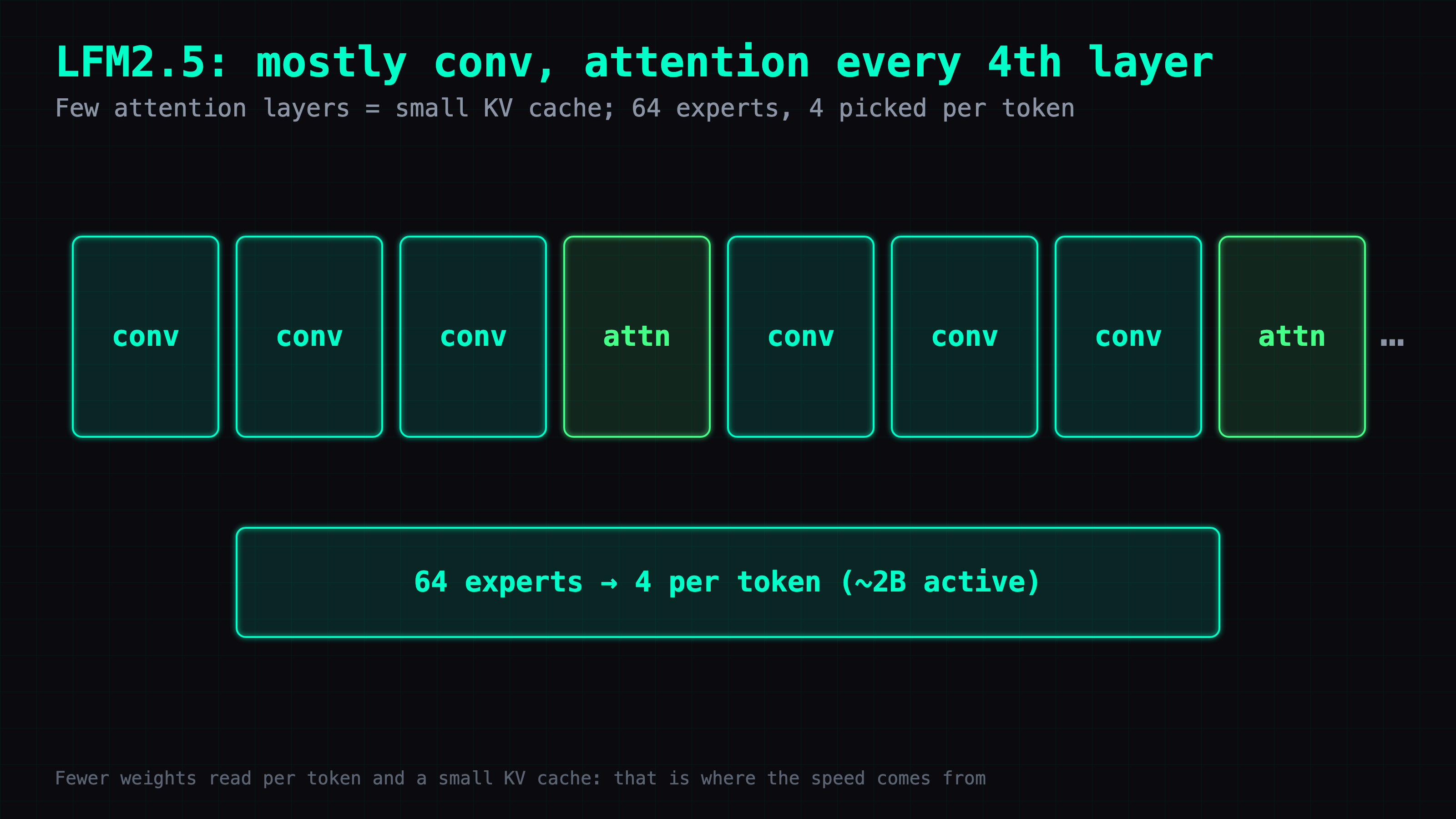
Per Liquid AI: 24B total, 2.45B active per token, 64 experts per MoE block with top-4 routing, and a 131,072-token context.
Three ways to run it on the same machine:
| 1 card, QAD Q4_0 13.6G | 1 card, Q4_K_M 14.5G | 2 cards, Q8_0 | |
|---|---|---|---|
| Prefill 512 / 8K / 32K (tok/s) | 3243 / 3286 / 2881 | 2864 / 2959 / 2631 | 3086 / 4930 / 4659 |
| Decode (tok/s) | 184.8 | 180.0 | 135.0 |
| Decode at 32K depth (tok/s) | not measured | 148.4 | 113.6 |
| Full 131,072 context | not measured | 17.4 GB | 14.2 GB per card |
QAD is Liquid's quantization-aware-distilled Q4_0. It's 0.9 GB smaller than Q4_K_M and decodes a bit faster. As with MiniCPM, one card decodes faster than two because the weights are smaller; two cards win on long-prompt prefill, roughly 1.5–1.7x at 8K and above.
On a 120K-token needle test, one card took 52 seconds (2,319 tok/s) and two cards 28 seconds (4,256); both answered correctly. MiniCPM needed 154 seconds for 165K tokens on one card, so LFM reads long documents much faster.
These numbers come from one night's setup: llama.cpp b11588, with another GPU running a separate test.
128/140, tied with the two-GPU 27B
Same 140 questions: GSM8K 50, MATH-500 30, MuSR 20, HumanEval+ 40.
| 2 cards, Q8_0, official sampling | 1 card, QAD Q4_0, Qwen sampling | |
|---|---|---|
| GSM8K | 49/50 | 47/50 |
| MATH-500 | 29/30 | 28/30 |
| MuSR | 15/20 | 14/20 |
| HumanEval+ | 35/40 | 36/40 |
| Total | 128/140 | 125/140 |
| Wall time | 3,169 s | 1,344 s |
The two-GPU 27B scored 128. The two columns differ in both quant and sampling, so I can't say which one costs the three points.
I normally run this set with thinking off. LFM can't turn it off, so it thinks on every question; the two-card run took 3,169 seconds, while MiniCPM with thinking off took 576.
Hard suite: better at instructions, worse at code, and some math answers cut off at 32K
Thinking on. One card ran QAD at temperature 0; two cards ran Q8_0 with the official sampling.
| 1 card QAD, temp 0 | 2 cards Q8_0, official | Qwen3.8-27B | |
|---|---|---|---|
| Math (AIME) | 23/30 (7 truncated) | 23/30 (6 truncated) | 21/30 |
| Reasoning (GPQA) | 21/30 | 23/30 | 25/30 |
| Instructions (IFEval) | 27/30 | 29/30 | 27/30 |
| Code (LiveCodeBench) | 9/20 (7 truncated) | 11/20 (6 truncated) | 14/20 |
"Truncated" means the thinking trace hit the 32K-token cap before an answer came out, which counts as wrong.
LFM did worst on these two:
- Agent bug fixing (Pi fixing real bugs in a repo, hidden tests in Docker, one card with QAD): 1/5. Its tool calls were well-formed; it just couldn't fix the other four within 20 turns. MiniCPM went 5/5.
- Three-hop lookup over 116K tokens: 0/10. I raised its answer budget to 8,192 tokens (2,048 for other models) because at 2,048 it spent the whole budget thinking on the first question and returned an empty string.
Use the official sampling: temperature 0 can think forever
I run evals at temperature 0 so results are reproducible. With LFM, some questions at temperature 0 never wrap up.
The median reasoning trace was 1,771 tokens, which is fine, but one question ran to 28K. In the one-card run, 7 math and 7 code questions hit the 32K cap.
The model card recommends temperature 0.1, top_k 50, and repetition_penalty 1.05. With those on the two-card run, reasoning went from 21 to 23, instructions from 27 to 29, code from 9 to 11, and truncations from 7 to 6. The quant also changed (Q4_0 to Q8_0), so not all of that is sampling. Truncations still happened, though: even with the recommended settings, hard problems can produce very long traces.
Send the three parameters with each request:
curl -s localhost:8080/v1/chat/completions -H 'Content-Type: application/json' -d '{
  "messages": [{"role": "user", "content": "What is 17 × 23?"}],
  "temperature": 0.1, "top_k": 50, "repeat_penalty": 1.05,
  "max_tokens": 8192
}'
Give max_tokens real headroom. The model thinks before every answer, even 17 × 23, and a small budget cuts it off before the answer appears. Adding "chat_template_kwargs": {"enable_thinking": false} does nothing; the model card says it always thinks.
Setup: QAD Q4_0 on one card with 131K context
You need a modded 2080 Ti 22G and a recent llama.cpp. I used b11588, built for sm_75 the same way as in #25.
mkdir -p ~/models/lfm25 && cd ~/models/lfm25
curl -L -C - --retry 5 -o LFM2.5-24B-A2B-QAD-Q4_0.gguf \
  https://huggingface.co/LiquidAI/LFM2.5-24B-A2B-GGUF/resolve/main/LFM2.5-24B-A2B-QAD-Q4_0.gguf
Launch:
./build/bin/llama-server \
  -m ~/models/lfm25/LFM2.5-24B-A2B-QAD-Q4_0.gguf \
  -ngl 99 -fa on -t 24 --jinja \
  -c 131072 -np 1 \
  --temp 0.1 --top-k 50 --repeat-penalty 1.05 \
  --host 0.0.0.0 --port 8080
--temp,--top-k, and--repeat-penaltyset server-side defaults for requests that don't send their own.- To serve several users, raise
-calong with-np. The deep dive explains why. - There's no speculative decoding to turn on: no MTP and no official draft model. N-gram speculation gave 2–5%.
Why it didn't replace the family chat server
Both models finished the same night. LFM decodes over 1.6x faster (184.8 vs 111.5 tok/s) and matched the 27B on the 140 set. I still picked MiniCPM:
- No vision. LFM is text-only; MiniCPM reads images.
- Thinking can't be turned off. Even short questions get a thinking pass first, which eats into the speed advantage.
- 1/5 on agent tasks. That server also handles agent tasks for me, and MiniCPM passed all five.
After testing I deleted the three LFM weight files (53.6 GB) and kept the results.
Deep dive: --kv-unified and 12 bogus errors, long-context runs, methodology
You can skip this section. It covers the KV pool trap when serving several users, why long-context questions need their own run, the sampling mismatch in my harness, and the methodology and environment.
With --kv-unified, -c is one shared pool
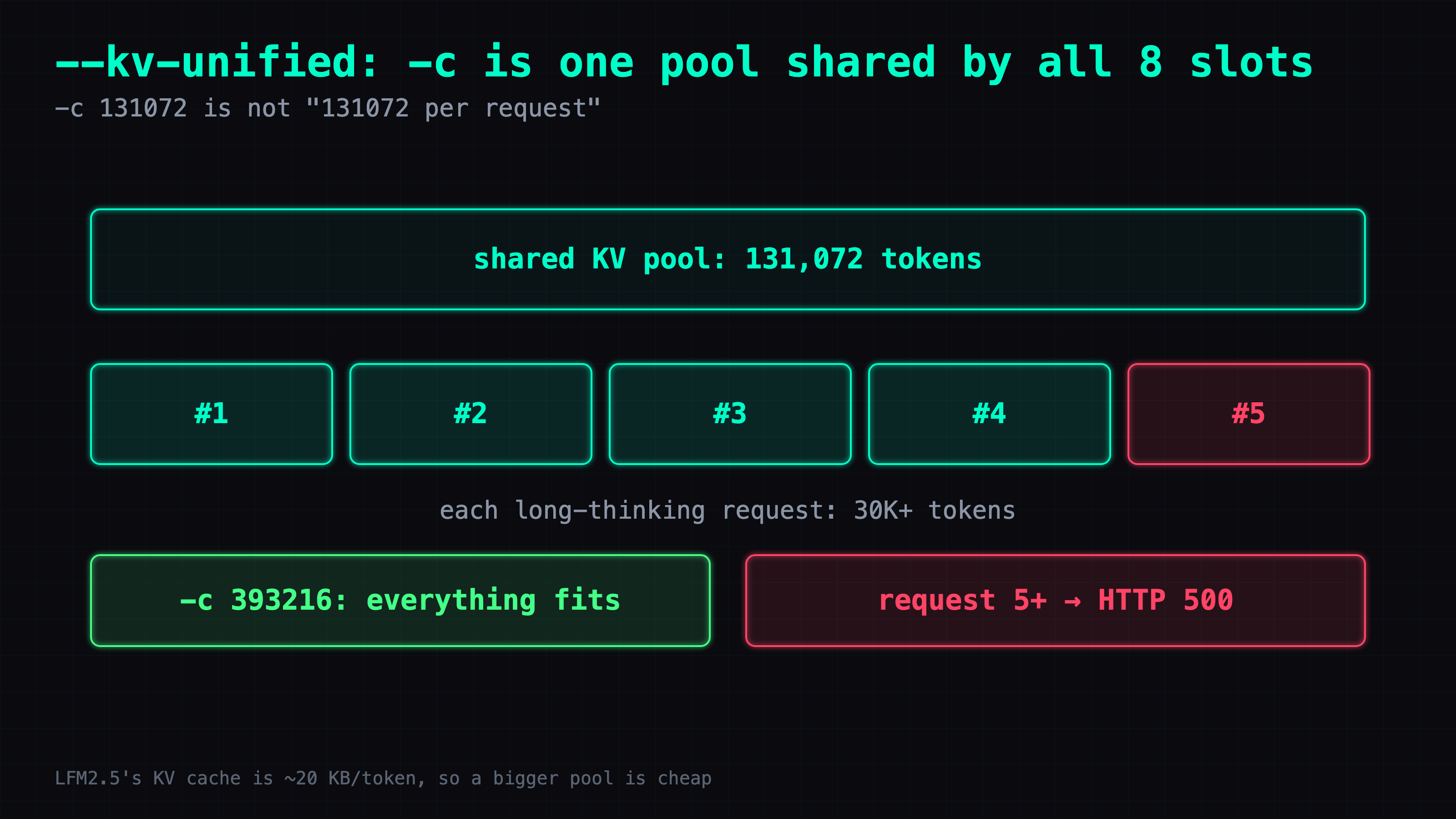
For the two-card runs I used 8 slots (-np 8), -c 131072, and --kv-unified, assuming each request could use up to 131,072 tokens. Twelve questions came back as HTTP 500 and my runner logged them as errors.
Under --kv-unified, -c is the total KV cache shared by all 8 slots. Each long-thinking LFM request took 30K+ tokens, so four in flight nearly filled the 131,072-token pool and the next one didn't fit.
With -c 393216, the server log reads:
llama_context: n_ctx_seq (393216) > n_ctx_train (131072) -- possible training context overflow
srv    load_model: initializing, n_slots = 8, n_ctx_slot = 131072, kv_unified = 'true'
Each slot is still capped at 131,072 (the training length), and the pool is 393,216. With only 10 attention layers, LFM's KV cache is about 20 KB per token, so a bigger pool is cheap and still fit on the two cards. Rerunning those 12 questions produced the scores reported earlier.
Long-context questions need their own run
A 116K-token question shares that same pool. When I ran the long-context set alongside the hard suite with a 131K pool, one long request took most of the cache and other requests started returning HTTP 500. I moved the long-context set to its own run.
My harness used Qwen's sampling
The 140-question runner defaults to Qwen's recommended sampling. I didn't change it for the one-card run, so 125 was measured with Qwen sampling; for the two-card run I switched to Liquid's settings and got 128.
Methodology
Speed: llama-bench with -ngl 99 -fa 1 -t 24, prompts of 512, 8192, and 32768 tokens, 128 generated tokens; the 32K-depth column adds -d 32768.
Context and needle: llama-server -c 131072, VRAM read from nvidia-smi; the needle prompt is about 120K tokens of random English words with a passphrase planted inside.
140 questions: two cards Q8_0 with the official sampling, one card QAD Q4_0 with Qwen sampling; HumanEval+ scored with evalplus.
Hard suite: thinking on, 32K cap per question. One card QAD at temperature 0; two cards Q8_0 with the official sampling (temperature 0.1, top_k 50, repeat_penalty 1.05).
Agent: one card, QAD; Pi fixes bugs in a real repo, up to 20 turns, hidden tests in Docker decide pass or fail.
Three-hop lookup: 116K tokens, 8,192-token answer budget, run on its own.
Caveats:
- Every test ran once, so there are no confidence intervals.
- The 27B scores came from an earlier date under slightly different conditions.
- On the speed-test night, another GPU was running a separate test.
Versions and hardware
- llama.cpp b11588, built for sm_75
- Model:
QAD-Q4_0andQ4_K_M(one card) andQ8_0(two cards) from LiquidAI/LFM2.5-24B-A2B-GGUF - Machine: EPYC, 128 GB RAM, three RTX 2080 Ti 22G; one-card tests on the third GPU, two-card tests on the first two (with the 27B stopped)
Not done yet
- The 140 set and hard suite on one-card QAD with the official sampling.
- Rerunning the truncated questions with a 64K cap, to tell long-but-finishing traces from real loops.
- A separate Chinese decode-speed measurement.
Also in this series: #25 MiniCPM-V 4.7 35B-A3B on one RTX 2080 Ti · #24 177B on 44 GB of VRAM: two 2080 Tis run Strata at 98.7 tok/s · #22 NVFP4 on a 2080 Ti without FP4 hardware
FAQ
- How fast is LFM2.5 24B-A2B on one RTX 2080 Ti 22G?
- The official QAD Q4_0 (13.6 GB) decodes at 184.8 tok/s with prefill at 3,243–3,286 tok/s. Q4_K_M (14.5 GB) decodes at 180.0, still 148.4 at 32K depth, and the full 131,072-token context uses 17.4 GB. A 120K-token needle-in-a-haystack prompt took 52 seconds on one card and was answered correctly.
- How does LFM2.5 24B-A2B compare with Qwen3.8 27B?
- On my 140-question set, two cards running Q8_0 with the official sampling scored 128, the same as the two-GPU Qwen3.8-27B it was compared against; one card running QAD Q4_0 with Qwen's sampling scored 125. On the hard suite (two cards, Q8_0) it got 23/30 math, 23/30 reasoning, 29/30 instructions, 11/20 code, against 21, 25, 27, and 14 for the 27B. Its weak spots: 1 of 5 agent bug-fix tasks and 0 of 10 on a 116K-token three-hop lookup.
- Can I turn off thinking in LFM2.5 24B-A2B?
- No. The model card describes it as a reasoning model that always thinks, and the chat template inserts a think tag before every answer. Passing enable_thinking false in the request had no effect; it even thinks before answering 17 × 23.
- What happens with LFM2.5 24B-A2B at temperature 0?
- Some prompts never stop thinking. The median reasoning trace was 1,771 tokens, but one question ran to 28K at temperature 0, and on one card 7 math and 7 code questions hit the 32K cap and were cut off. The official sampling (temperature 0.1, top_k 50, repeat_penalty 1.05) scored better, but 6 math and 6 code questions were still truncated.
- What does -c mean when llama-server runs with --kv-unified?
- It is the total KV cache shared by all slots, not a per-request limit. With 8 slots and -c 131072, each long-thinking request used 30K+ tokens, four of them nearly filled the pool, and the next one got HTTP 500. With -c 393216 the log shows 131,072 per slot and 393,216 total, and the errors stopped.
Read next
- 2026-10-16MiniCPM-V 4.7 35B-A3B on One RTX 2080 Ti: 111.5 tok/s with Vision, Replacing a Two-GPU 27B
MiniCPM-V 4.7 35B-A3B on a single modded RTX 2080 Ti 22G with llama.cpp: 111.5 tok/s, 262K context in 20.8 GB, 127/140 vs 128 for a two-GPU Qwen3.8-27B. Setup, benchmarks, and why its DSpark draft model makes it slower.
- 2026-08-28[Benchmark] A 177B MoE on Three Modded 2080 Tis: 23 tok/s at 128K, 77 on a File Edit
Qwen3.8-Flash-Next (176.94B, arch qwen4exp) runs on 3× modded 2080 Ti 22G at 23.14 tok/s at 128K context — and 3.51× that on a file edit, with no draft model.
- 2026-10-14177B on 44 GB of VRAM: Two 2080 Tis Run Qwen3.8-Flash-Next at 98.7 tok/s with Strata
Two modded 2080 Ti 22GB cards and 128 GB of RAM run the 177B Qwen3.8-Flash-Next under Strata at 98.7 tok/s for one user. Multi-user numbers vs a 27B.
- 2026-10-06Qwen3.8-Flash-Next 177B on One RTX 2080 Ti: Strata Runs Code at 70 tok/s
One modded 2080 Ti 22GB plus 128 GB of RAM runs the 177B Qwen3.8-Flash-Next (IQ3_S) under Strata at 70.3 tok/s on code, next to a 27B on the other two cards.
Don't miss the next one
Subscribe, and you won't.
One-click unsubscribe anytime.