AI Workflow · part 33
[Guide] Which Local AI Model for Which Job: What We Actually Run (Updated as We Switch)
❯ cat --toc
- DeepSeek gets the jobs that need to finish
- MiniCPM frees an old GPU for other work
- For news animation, I check what the scene communicates
- Generated pictures and speech still need a final pass
- Why Bonsai and Inkling aren't my daily drivers
- Deep dive: deployment history and the full test comparisons
- Terms used in the measurements
- Full conditions behind the quick reference
- Task diagram and cover
- Lineup with full configuration names
- Local LLMs: a primary agent, a backup and a fast assistant
- Images: start with Qwen-Image 2.1 Turbo
- Video: preview speed, dialogue and camera control are separate choices
- Speech: Vox Q8 narrates; Whisper transcribes and aligns
- Coding and reasoning: require a usable answer and a finished job
- Older GPU configurations and the move to MiniCPM
- Qwen's earlier dual-card setup and diagnostic comparison
- Why a question score is only part of the decision
- Evidence from old benchmarks and replacement candidates
- Matched preview timing and older dialogue examples
- Update log
TL;DR
I use DeepSeek for long jobs, debugging, and important draft reviews; Qwen covers it when busy. MiniCPM handles routine questions and screenshots on a modified older graphics card. Qwen-Image, Vox, and Whisper cover illustrations, narration, and transcription. Multi-step work needs software that opens files, runs programs, checks results, and retries. I keep models that deliver usable code, tests, or reports on my work.
This is my current task list, based on dated tests and the work I actually finish with each model.
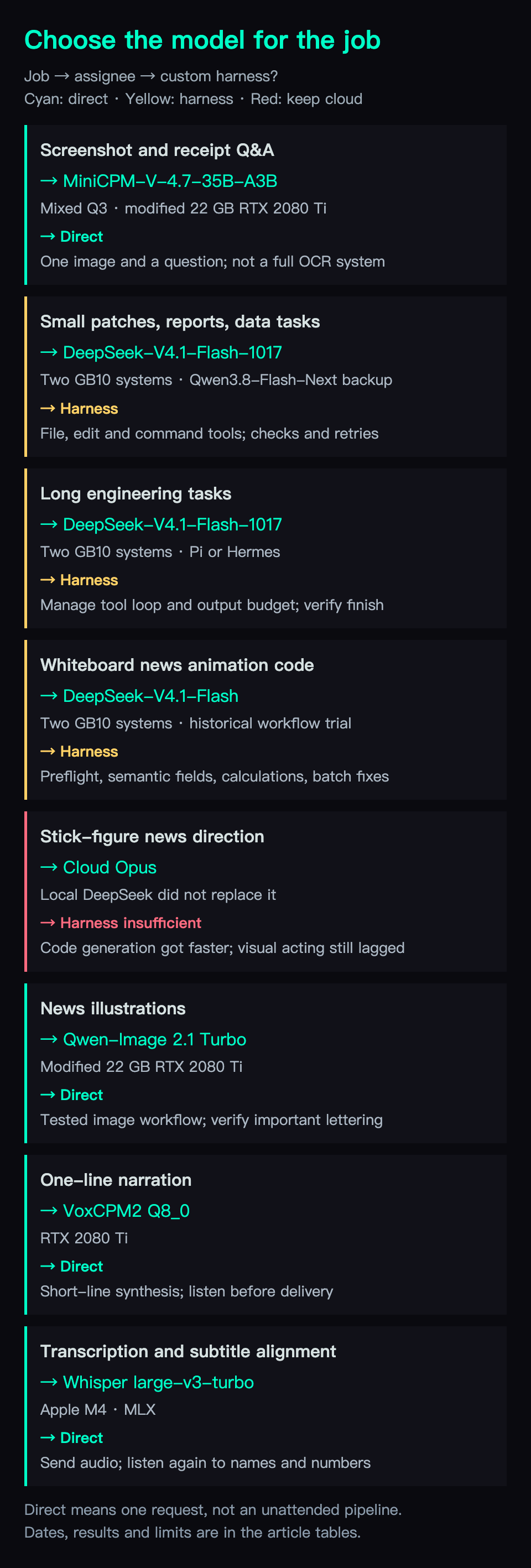
- Screenshot or receipt: MiniCPM, direct request.
- Patch, report, or data task: DeepSeek with a harness.
- Long job with repeated edits and checks: DeepSeek with a harness.
- Whiteboard news animation: DeepSeek with a harness, writing the code that draws and animates it.
- Stick figure news storyboard and animation code: Claude Opus, in the cloud, with a harness.
- Illustration: Qwen-Image, direct request.
- Narration: Vox, direct request.
- Transcription and timing: Whisper, direct request.
DeepSeek gets the jobs that need to finish
DeepSeek is my first choice when a task involves reading files, changing them, running something, checking the output, and doing it again. I also use it for important draft reviews and debugging. The version I currently deploy needs two NVIDIA DGX Spark desktop boxes.
Qwen is the backup when DeepSeek is busy. It found the causes of failures in our real incident logs, so I kept it for reviews, debugging, and longer jobs.
For these jobs, the model needs a harness: extra software that lets it open files, run programs, inspect results, and retry. The model can propose a patch in a chat window. Applying it, running the tests, reading a failure, and fixing it requires that surrounding software.
A single question, image request, or audio request can go directly to the model. I don't need a file-editing loop to ask what a receipt says.
MiniCPM frees an old GPU for other work
MiniCPM handles my routine questions, screenshots, and quick reviews. It responds quickly enough for everyday use on one RTX 2080 Ti.
The card originally had 11 GB of memory. Mine has had its memory chips replaced, taking it to 22 GB and allowing a larger model to fit. The MiniCPM deployment write-up covers that setup.
My previous everyday model needed two old graphics cards. Moving this work to MiniCPM on one card leaves the other available. These requests no longer have to wait for the large model.
The DGX Spark pair has gone through several models too. I once swapped in a faster inference engine, it ran out of memory on long inputs, and I rolled back. The memory failure and rollback has its own write-up.
For news animation, I check what the scene communicates
DeepSeek writes the code for my whiteboard news animations. The drawings and motion come from that code, rather than a video model generating the whole shot.
I still use Claude Opus in the cloud for stick figure news storyboards and animation code. The local model writes code quickly, but its visual scenes don't convey the news events well enough yet.
For a generated shot, Pika-H3 gave me faster previews with the speed-up setup I tested (details in the deep dive). LTX generates sound and video together. I listen to the whole dialogue before accepting a clip, including who says each line and whether the words are correct.
When I need a specific camera move, I build a rough 3D whitebox scene as a visual reference. It gives the video model a concrete view of the composition and movement I want.
Generated pictures and speech still need a final pass
Qwen-Image is my illustration default because it scored higher on the same real work tasks I used to compare the candidates. For Traditional Chinese text, I inspect the output character by character. The overall image score does not measure lettering accuracy. If the caption has to be exact, I add it afterward.
Vox narrates in my voice. A faster 4-bit version of the voice model sometimes garbled an entire line, so I went back to the 8-bit one. I listen to every line and check timing, names, and numbers before using the audio.
I also run an automated speech-to-text check on narration. I give that check the audio without the intended script. Supplying the script can steer the transcription toward what the line was supposed to say and hide a spoken mistake.
Whisper remains my choice for transcription and timing because it made fewer errors in my comparison. I still check its output against the audio, especially names and numbers.
Why Bonsai and Inkling aren't my daily drivers
Bonsai and Inkling are new candidates we tested for coding and reasoning. I still use the models above for that work.
Bonsai did better on hard questions than an earlier MiniCPM version. It did worse at troubleshooting the real failures I gave it, and it failed to finish within a fixed output length limit. I check the delivered code, tests, and report before calling a job finished.
Inkling's question scores improved when I gave it more computation. I don't yet have enough evidence from actual work to make it a daily driver.
These are dated comparisons on my tasks. I update this guide when I switch models; the full replacement history belongs in a separate article.
The latest update date is at the end.
Deep dive: deployment history and the full test comparisons
You can skip this section without changing how you use the recommendations above. It keeps the earlier configurations and detailed evidence behind those choices.
Terms used in the measurements
- Quantization (Q8, Q4, Q3, IQ3_S, NVFP4): ways to store a model in less GPU memory; Q8_0 and Q4_K_M are labels in this family too. Lower numbers generally mean less memory and faster responses, with a possible loss in quality.
- tok/s: tokens generated per second; a token is roughly a character or a fragment of a word. Higher means faster text generation.
- CER/WER: transcription error rates measured by character or word. Lower is better.
Full conditions behind the quick reference
- Context: how much text the model can read in one request, including the material and conversation you give it.
I assign models by the job I have tested. A receipt question, a repository patch, and a finished news animation need different evidence.
In the tables, direct means the stated single request works without my custom agent harness. It says nothing about running an autonomous production pipeline.
For engineering and animation, read the harness column before copying my model choice. These results reflect both the model and the workflow I tested.
| Job and assignee | Dated evidence | Custom harness: classification and work | My advice |
|---|---|---|---|
| Patching existing code, reading files into reports, and small data jobs: DeepSeek-V4.1-Flash-1017 across two GB10 systems with TensorFold (inference software that runs the model on this hardware). Qwen3.8-Flash-Next IQ3_S with Strata (inference software for running this model on the older GPUs below) is my backup. | 2026-11-22: DeepSeek completed 6/6 small trials in each of Pi, dsh, and Hermes. These agent runners are harnesses: they wrap the model and let it read files and run commands. Pi's median elapsed time was 26.9 s. | Required. The agent runners provide file access, editing, and command tools. Checks and retries belong in that loop. | I use this local pair for the existing jobs listed here. My dispatch policy sends changes involving databases or approval records, refactors across files, and projects built from scratch to Codex. That is a routing decision, not a measured limit on the local model. |
| Long engineering tasks: DeepSeek-V4.1-Flash-1017, with Pi or Hermes as the tested candidates. | 2026-11-22: mean functional scores were 100% for Pi and Hermes, versus 75% for dsh. There were two runs per cell. Some full-score runs reached the 45 min deadline without a final report. | Required. Manage the tool loop and output budget. Check that the agent has finished and produced its report. | I check the tests and final report before assigning long jobs. A functional score does not establish a completion rate. |
| Whiteboard news animation code: DeepSeek-V4.1-Flash, across two GB10 systems. | 2026-10-26 to 2026-10-27: harness changes took one repeated topic from 80.6 min to 5.4 min. A later blind comparison preferred the 10.7 min run with high reasoning. | Required. Run preflight checks. Ask for structured semantic fields, then calculate coordinates, text boxes, and timing in code. Stage tool permissions, check outputs, and fix errors in batches. | On each iteration, I remove one kind of repetitive work. The 5.4 min result is historical evidence for that same topic. It does not establish unseen-topic speed or a general quality setting. |
| Storyboarding and generating animation code for stick-figure news shorts: keep cloud Opus. | 2026-11-17 to 2026-11-18: the local DeepSeek workflow generated code for new topics in 7–15 min. Visual acting remained worse: events became documents, checks, and arrows. | Required in the pipeline, insufficient to replace Opus. The harness can organize and check the code generation. That did not fix the visual acting in these trials. | I inspect the film. Faster local code generation is not enough evidence to recommend a local replacement for Opus here. |
For these four image and audio jobs, a direct request is enough for the narrow use listed. The last column describes what I still inspect.
| Job and assignee | Dated evidence | Custom harness: classification and work | My advice |
|---|---|---|---|
| Screenshot or receipt Q&A: MiniCPM-V-4.7-35B-A3B, mixed Q3, on one modified 22 GB RTX 2080 Ti. | 2026-10-14: it read a Traditional Chinese receipt correctly. This was one image, not an OCR benchmark. | Direct for image Q&A. My custom agent harness is unnecessary for that single request. | I use it to ask questions about screenshots and receipts. I would test my own document set before treating it as an OCR system. |
| News illustrations: Qwen-Image 2.1 Turbo on a modified 22 GB RTX 2080 Ti. | 2026-11-23: 12 prompts scored 96.75/100 with one blinded MiniCPM-V judge. Warm median generation time was 14.28 s. | Direct generation. No custom agent harness is needed to produce the image. | I use it for news illustrations. I check Traditional Chinese text character by character. The score comes from a single model judge. |
| One-line narration: VoxCPM2 Q8_0 on an RTX 2080 Ti. | 2026-10-18: in a paired six-line test, Q8 averaged 1.54 s and Q4 1.38 s. Later, occasional whole-line corruption in Q4 led me back to Q8. I did not measure its failure frequency. | Direct for a short line. Full production may need pronunciation handling and listening checks. | I use Q8 for short narration and listen to the output. Raw TTS generation does not cover autonomous publishing. |
| Transcription and subtitle alignment: Whisper large-v3-turbo via MLX on an Apple M4. | 2026-11-17: the same 45 Chinese and 17 English utterances, without hints, produced 8.08% Chinese character error rate and 8.67% English word error rate. | Direct audio transcription and alignment. No custom agent harness is needed for the stated request. | I listen again to names and numbers. I do not feed the intended script into transcription and then use the resulting match as proof that the narration was correct. |
Task diagram and cover
Lineup with full configuration names
Our local lineup: DeepSeek for long agent runs, Qwen Flash Next as backup, MiniCPM for quick text and image work, Qwen-Image Turbo for illustrations, and VoxCPM2 Q8 plus Whisper for narration and alignment. Start with the task list, then check the hardware and acceptance criteria. We keep this guide updated while retaining each test's original date and scope.
Local LLMs: a primary agent, a backup and a fast assistant
I give the local LLMs three different jobs. DeepSeek gets long agent runs and reviews that need close attention. Qwen Flash Next backs it up. MiniCPM handles quick questions, screenshots and routine review.
Large: DeepSeek for long agent runs
I run DeepSeek-V4.1-Flash-1017 through TensorFold across two GB10 systems. It gets extended agent work, careful manuscript review and troubleshooting that requires working through files, edits and checks. In the trials, it completed 6/6 small tasks in each of Pi, dsh and Hermes. Those small trials do not establish whether it will finish a long job; I check the tests and final report myself.
Medium: Qwen Flash Next for backup review and diagnosis
Qwen3.8-Flash-Next IQ3_S runs through Strata on one RTX 2080 Ti. I use it when I need a second local model for diagnosis or review. On real failure logs, it earned 14/21 rubric points, meaning points out of the total available for finding causes, rather than a percentage of jobs completed.
Small and fast: MiniCPM for quick text and image questions
MiniCPM-V-4.7-35B-A3B runs through llama.cpp (inference software that runs the model on this hardware) on one modified 22 GB RTX 2080 Ti, using mixed Q3 quantization. The model is large, but it uses a small part of itself at each step, keeping responses fast on an older card. I use it for routine questions, screenshots and everyday review. Text generation measured 111.5 tok/s in the single-card test.
Later memory adjustments let vision and long text requests fit together on the same card. That leaves the other cards available for Qwen Flash Next and image generation.
How the daily models changed
On GB10, I moved from Qwen3.5-35B to DeepSeek-V4-Flash, then to the current dual-GB10 DeepSeek V4.1 Flash setup. Along the way, a faster engine ran out of memory with large requests. I rolled that deployment back before moving on to the current model.
On the older GPUs, MiniCPM replaced a daily model that occupied two cards. Combining text and image questions on one card left another GPU available for the backup model. The earlier configurations and their measurements are in the deep dive below.
Images: start with Qwen-Image 2.1 Turbo
What I run
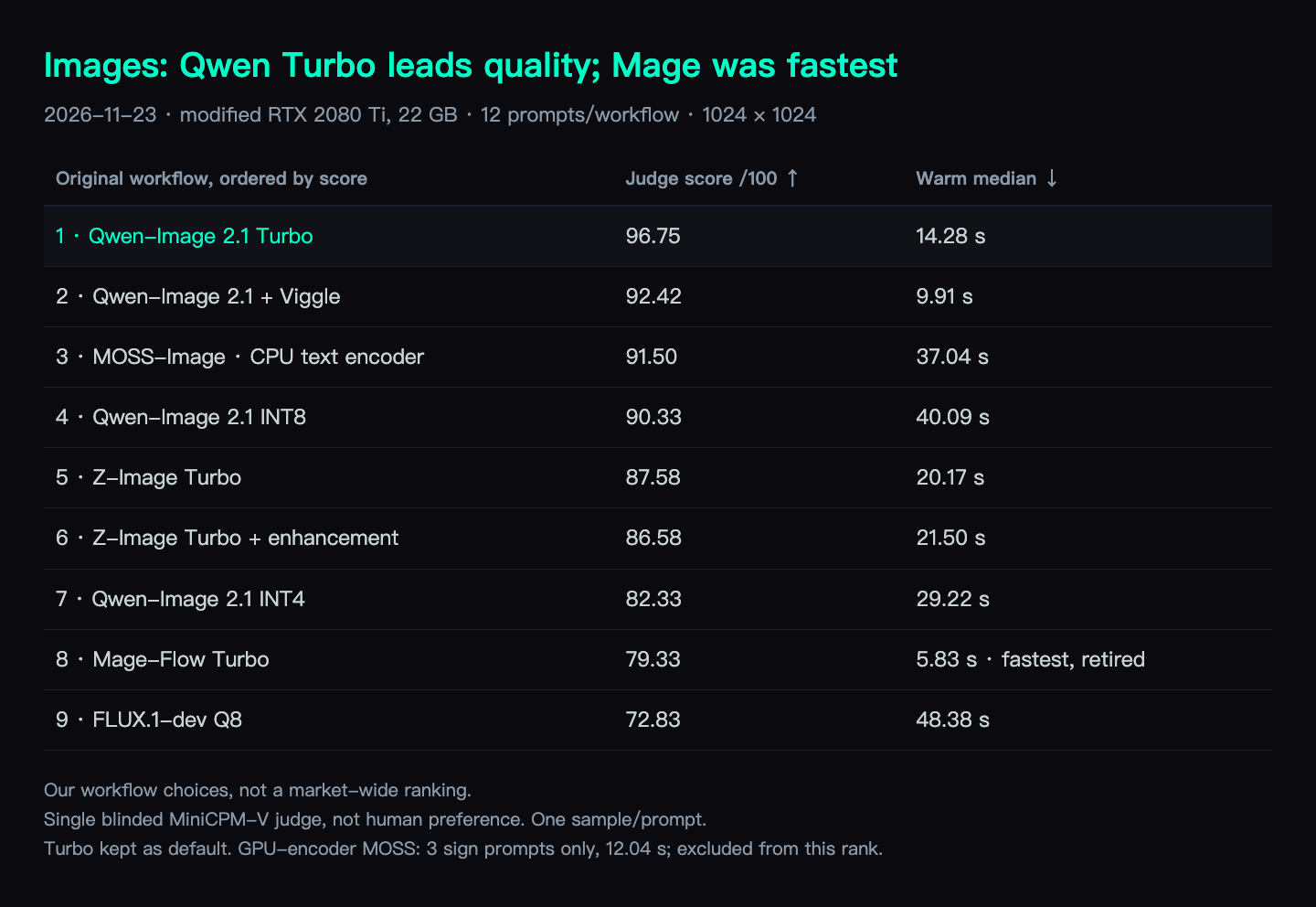
Qwen-Image 2.1 Turbo is our accelerated image workflow for news illustrations, running on a modified 22 GB RTX 2080 Ti. MOSS-Image is the alternative. I inspect important Traditional Chinese lettering and typeset exact captions afterward.
Why it gets the job
On November 23, 2026, Qwen scored 96.75/100 in our 12-prompt test and took a warm median of 14.28 seconds with the narration model also resident in VRAM. Each workflow produced one 1024 × 1024 image per prompt. One MiniCPM-V judge scored anonymized images. This is neither a human preference percentage nor a Chinese text accuracy score: images without lettering could also receive text points.
Evidence from earlier choices
We used Mage-Flow Turbo too. It took 5.83 seconds in that test but scored 79.33/100, so I removed it and kept Qwen as the default. MOSS's original workflow scored 91.50/100 at 37.04 seconds; a later GPU text-encoder setup reached 12.04 seconds on just three fixed prompts for Traditional Chinese storefront signs. The original quality score does not tell us how well that smaller follow-up performed. The earlier MOSS lettering and deployment experiments have their own write-up; the scores here come from the November 23 work prompts.
Video: preview speed, dialogue and camera control are separate choices
What I run
Pika-H3 accelerates MiniMax-H3; Turbo is where I start for a quick shot preview. LTX-2.5 generates video and audio together, but a dialogue shot still needs a full listen. For stick-figure news direction, I keep cloud Opus. The task table records why the local DeepSeek workflow has not replaced it.
Turbo was the fastest preview option in the matched shot I timed. That test does not settle dialogue quality: listen to the complete exchange, including speaker changes. For a prescribed camera move, I start with a simple 3D scene that shows the camera route, then use it as the reference.
Speech: Vox Q8 narrates; Whisper transcribes and aligns
What I run
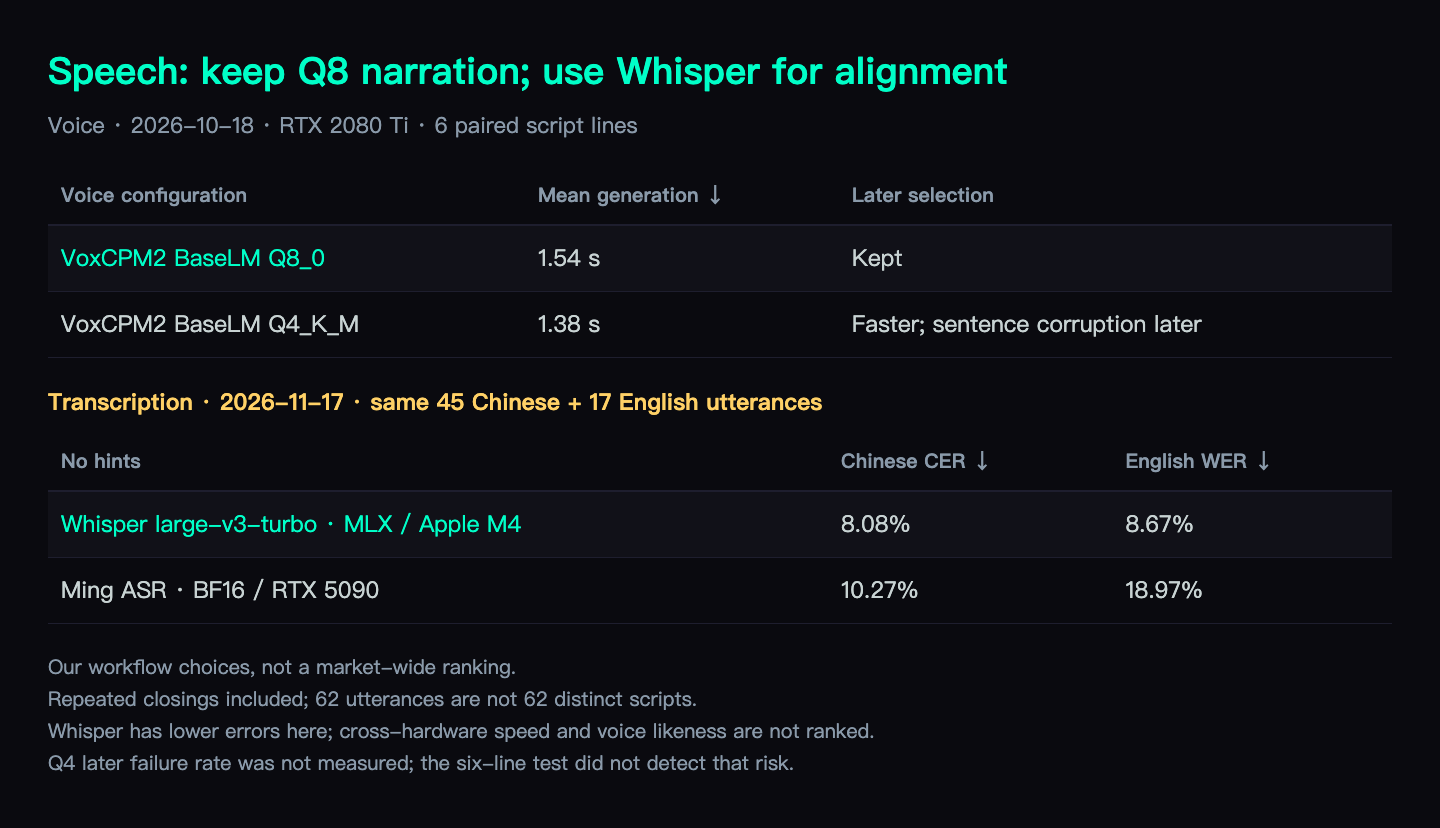
VoxCPM2 is the voice-cloning model I use for narration, with its main language model quantized to Q8_0 on an RTX 2080 Ti. Whisper large-v3-turbo runs through MLX on an Apple M4 for transcription and subtitle alignment. For CPU transcription I use Qwen3-ASR GGUF.
Why I keep synthesis and checking separate
A clean transcript cannot prove that a voice sounds right. I listen to each line, check subtitle timing, and revisit names and numbers in the original audio. In our November 17 unprompted test, Whisper produced 8.08% Chinese CER and 8.67% English WER across 45 Chinese and 17 English utterances. Repeated closings were included; these were not 62 distinct scripts. Feeding the intended script into the recognizer can conceal a narration mistake.
Evidence: returning from Q4 to Q8
The October 18 paired six-line test favored Vox Q4_K_M on speed: 1.38 seconds on average versus Q8_0's 1.54. Later, Q4 occasionally garbled an entire sentence, so I returned to Q8. We did not measure that failure rate. In the transcription comparison, Ming-3.0-asr-tiny BF16 on an RTX 5090 had 10.27% CER and 18.97% WER. I kept the lower-error Whisper setup without treating cross-hardware latency as a model speed ranking. The old FP32 accuracy scores do not apply to the current Qwen3-ASR GGUF setup. See the narration workflow and upstream Whisper repository for implementation details.
Coding and reasoning: require a usable answer and a finished job
I kept the daily assistants; Bonsai and Inkling have not replaced them.
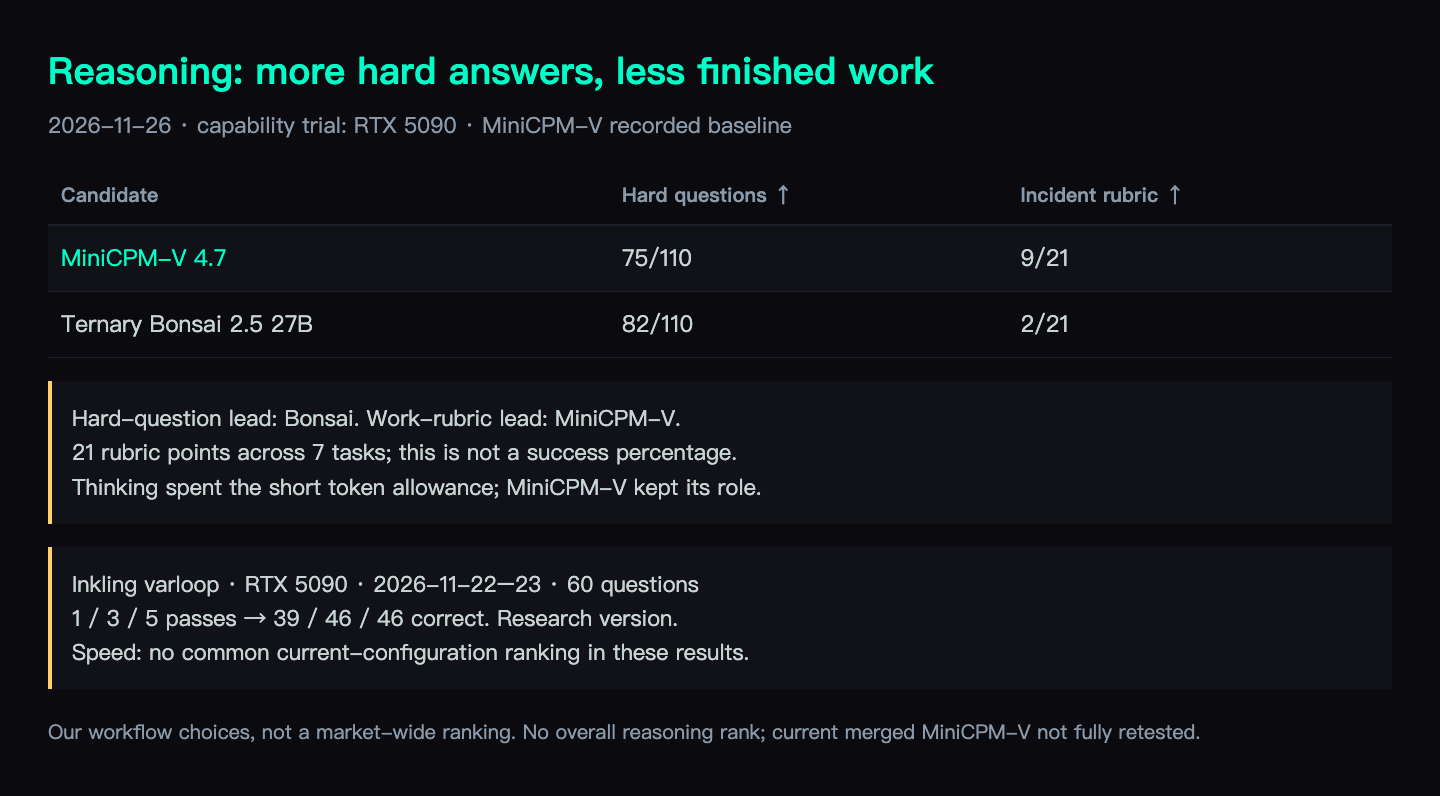
Bonsai beat the earlier MiniCPM baseline with 82/110 hard questions answered correctly, where the denominator is the number of questions, but scored 2/21 rubric points on real incident diagnostics against MiniCPM's 9/21 rubric points, each measured against the total available points. Under the fixed output budget, Bonsai spent too much time thinking and left answers unfinished; turning thinking off led to repeated file lookups. Inkling improved when allowed extra computation, but that question test gave me no reason to replace the assistant handling my daily work.
Older GPU configurations and the move to MiniCPM
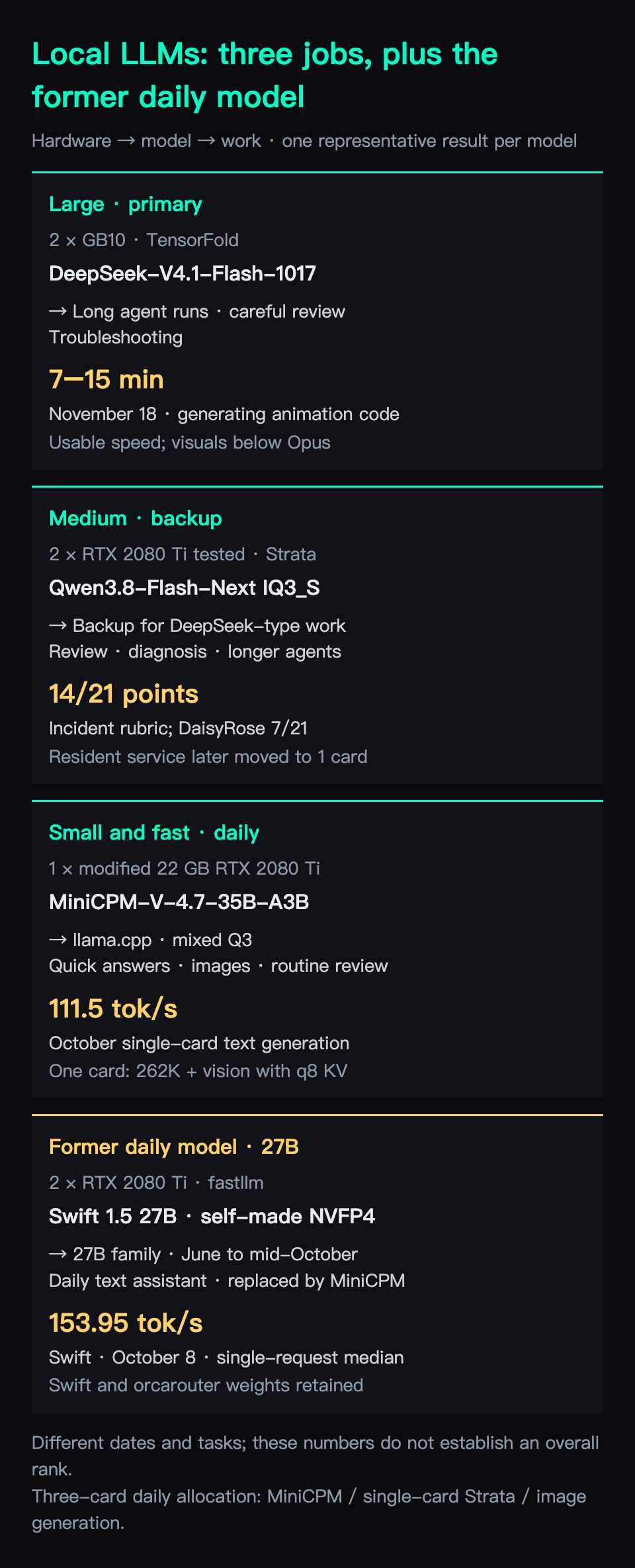
Three snapshots record the change: Qwen3.6-27B on one card with llama.cpp, self-converted NVFP4 27B on two cards with fastllm (inference software that runs the model on this hardware), and MiniCPM's single-card deployment.
The final 27B daily configuration was Swift 1.5, converted to NVFP4 and served through fastllm on two cards. Its median single-request coding speed was 153.95 tok/s. We still have the converted Swift weights. MiniCPM took over on October 14, 2026; the article appeared on October 16. The speeds from these setups cannot be compared directly.
In the October 14 single-card mixed-Q3 test, MiniCPM also completed all five agent tasks through Pi. The initial configuration fit a 262K text-only context but ran out of memory with the vision module. Later memory adjustments fit vision and a 262K context together on one card, using 20.4 GB of VRAM.
Qwen's earlier dual-card setup and diagnostic comparison
I kept Strata version 0.2.10. An October test using layer splitting across two RTX 2080 Ti cards produced 98.7 tok/s for one coding request. I later moved the resident service to one card. The troubleshooting comparison gave Qwen 14/21 rubric points against DaisyRose's 7/21. Reviewing that result in November, I kept Qwen for backup review, diagnosis and longer agent tasks.
Why a question score is only part of the decision
Bonsai 2.5 is the ternary-compressed 27B candidate; Inkling varloop is a research model that repeats intermediate computation. Neither has replaced the daily assistants.
On November 26, 2026, Bonsai answered 82/110 hard questions on an RTX 5090, versus 75/110 from an earlier MiniCPM Q8 baseline. When I asked them to find causes in real failure logs under a fixed token cap, Bonsai scored 2/21 and MiniCPM scored 9/21. Seven tasks were worth three points each; these are rubric scores, not completion percentages. Bonsai spent its output allowance thinking and left answers unfinished. Disabling thinking led to repeated file lookups, so I kept the existing assistant.
Evidence from old benchmarks and replacement candidates
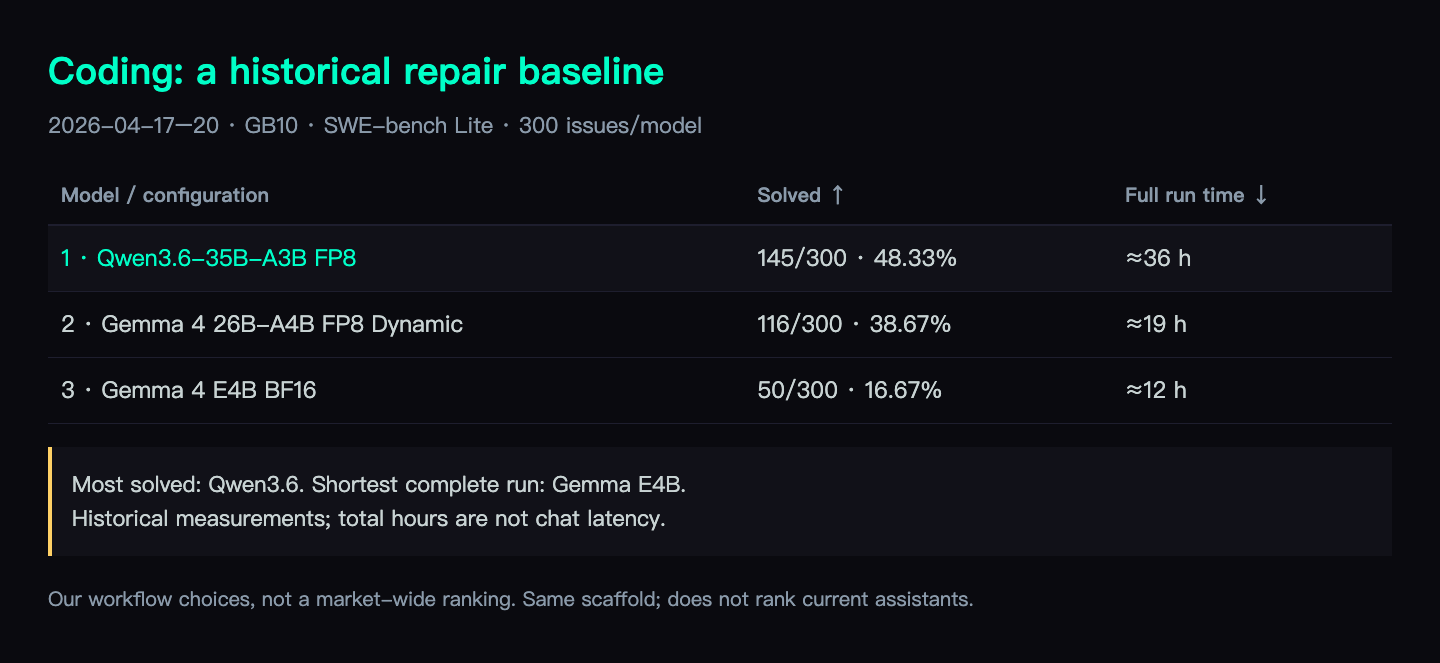
Our April 17–20 GB10 SWE-bench Lite runs used the same agent scaffold and all 300 issues per model. Qwen3.6-35B FP8 solved 145, Gemma 4 26B FP8 Dynamic solved 116, and Gemma E4B BF16 solved 50. The three-model repair write-up records historical results, not today's dispatch order; the three-tier section above records the actual daily 27B replacement.
On November 22–23, Inkling's variable-loop research checkpoint, answered 39, 46 and 46 of the same 60 questions with one, three and five passes on an RTX 5090. Extra computation helped up to three passes in that test. The earlier Bonsai 2 speed test on an RTX 2080 Ti cannot be paired with the RTX 5090 capability score above as though they described one configuration.
Matched preview timing and older dialogue examples
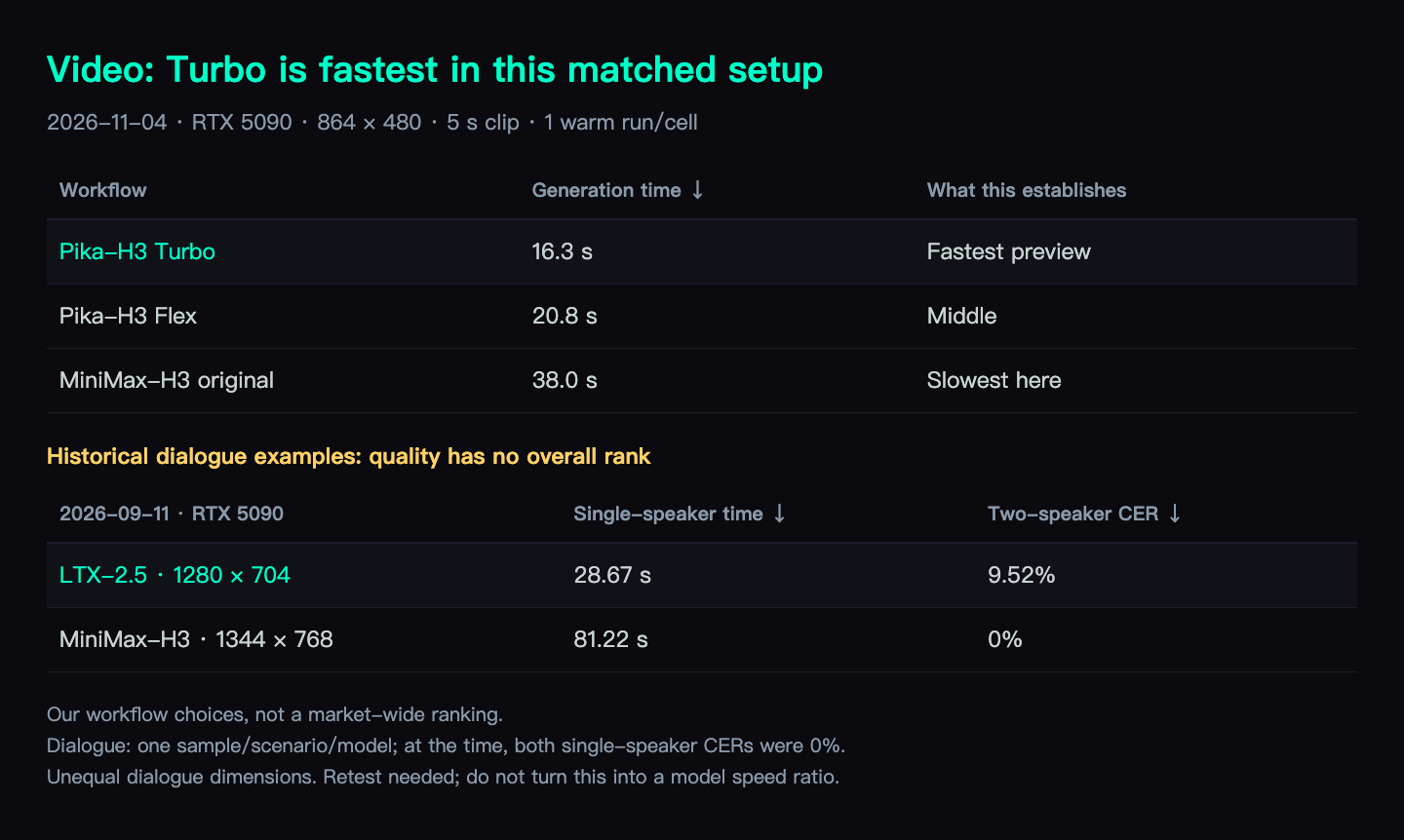
On November 4, 2026, one warmed five-second shot on an RTX 5090 took 38.0 seconds with original H3, 20.8 with Flex and 16.3 with Turbo. The input frame, seed (the same random starting value) and 864 × 480 output size matched. That supports trying Turbo first for previews; a single run per cell tells us little about variance or overall quality.
Our September 11 LTX-2.5 and H3 dialogue trials had zero character error in the single-speaker examples. With two speakers, LTX's whole-clip CER was 9.52% and H3's was zero. These were individual examples with different output sizes, so they do not tell me which model to use overall. The Pika-H3 camera experiment records those comparisons.
Update log
- 2026-11-27: first edition. Added the task reference, three local LLM tiers and evidence behind each workflow choice. Future changes will update this page and its
updatedAtdate.
FAQ
- Which local image model did you keep?
- Qwen-Image 2.1 Turbo is our default. It scored 96.75/100 across 12 prompts with MiniCPM-V-4.7-35B-A3B as the single blinded vision-model judge on November 23, 2026, and its warm median was 14.28 seconds on a modified 22 GB RTX 2080 Ti. These are our workflow results, not a market-wide ranking.
- Does a higher reasoning score mean a better local agent?
- Our Bonsai 2.5 test says it can go the other way. It did better on hard questions but worse at finding causes in real failure logs under a fixed token cap for thinking and answers, so we kept MiniCPM-V.
- Why keep VoxCPM2 Q8 when Q4 was faster?
- Q4 occasionally corrupted an entire sentence in later use. We returned to Q8 for narration.
Read next
- 2026-11-23[Benchmark] Antigravity Orchestrator and /swarm on my coding tickets: same score, 1.2 to 7.7 quota points
I ran Antigravity Orchestrator, /swarm, and solo models on my coding tickets. Equal scores cost 1.2–7.7 quota points. Commands, baselines, and every run.
- 2026-11-09[AI Workflow] A Self-Running AI News Shorts Pipeline on Local Models: Harness Changes Cut Director Time From 80.6 to 5–10 Minutes
My pipeline makes Chinese and English news shorts 4 times a day. A new harness took the local DS4.1 director from 80.6 to 5–10 minutes per video.
- 2026-11-04[AI Workflow] Teaching a Chinese TTS Taiwan Mandarin: a 3-to-80-Entry Lexicon Plus g2pW Auto-Tagging
VoxCPM2 read Taiwan Mandarin with mainland readings. A shared lexicon (3 to 80 entries), g2pW auto-tags and a few text rules fixed it before the TTS.
- 2026-10-19[Dev Workflow] One RTX 2080 Ti Narrates Every Daily AI-News Short: VoxCPM2 GGUF Q4_K_M at Under 2 s per Line
VoxCPM2 cloned in my own voice, quantized to GGUF Q4_K_M, runs on one RTX 2080 Ti under 2 s a line. Build, resident service, and the whisper gate fixes.
Don't miss the next one
Subscribe, and you won't.
One-click unsubscribe anytime.