AI Agent Life, from Zero · part 8
[Agent 101 #8] One person, a whole team of assistants: each with its own desk, brain, and memory
❯ cat --toc
- The plain version: instead of one assistant doing everything, raise a team of specialists
- This is the advanced track — make sure you actually need it
- What's a "separate assistant"? Several independent ones on the same computer
- Each gets a "home": its desk, drawers, and nameplate
- Each runs its own brain, each minds its own job — why that's useful
- The ones I run: my main, my creative one, my research one
- Takeaways
- A separate assistant is about "isolation," not "copies"
- One person can be the owner of a whole team
- Don't split for the sake of splitting
- Conclusion
TL;DR
Once you're comfortable with one assistant, you'll want a second and a third — one watching stocks, one writing, one researching. Hermes makes that possible: each assistant gets its own independent "home" with its own config, memory, and personality, and each can run a different brain. They live on the same computer, but separate desks, separate brains, separate memory — no interference. I run three myself: my main one, a creative one, and a sharp-tongued research one. (Hermes officially calls these profiles.) Honest take: one assistant is enough for most people; this is for when you have several distinct uses, or you just like to tinker.
The plain version: instead of one assistant doing everything, raise a team of specialists
After the first seven posts you've got an assistant that runs tasks on its own and messages you. After using it a while, you start wondering:
Can I have a second one? This one watches my stocks, that one writes for me — and ideally they don't step on each other.
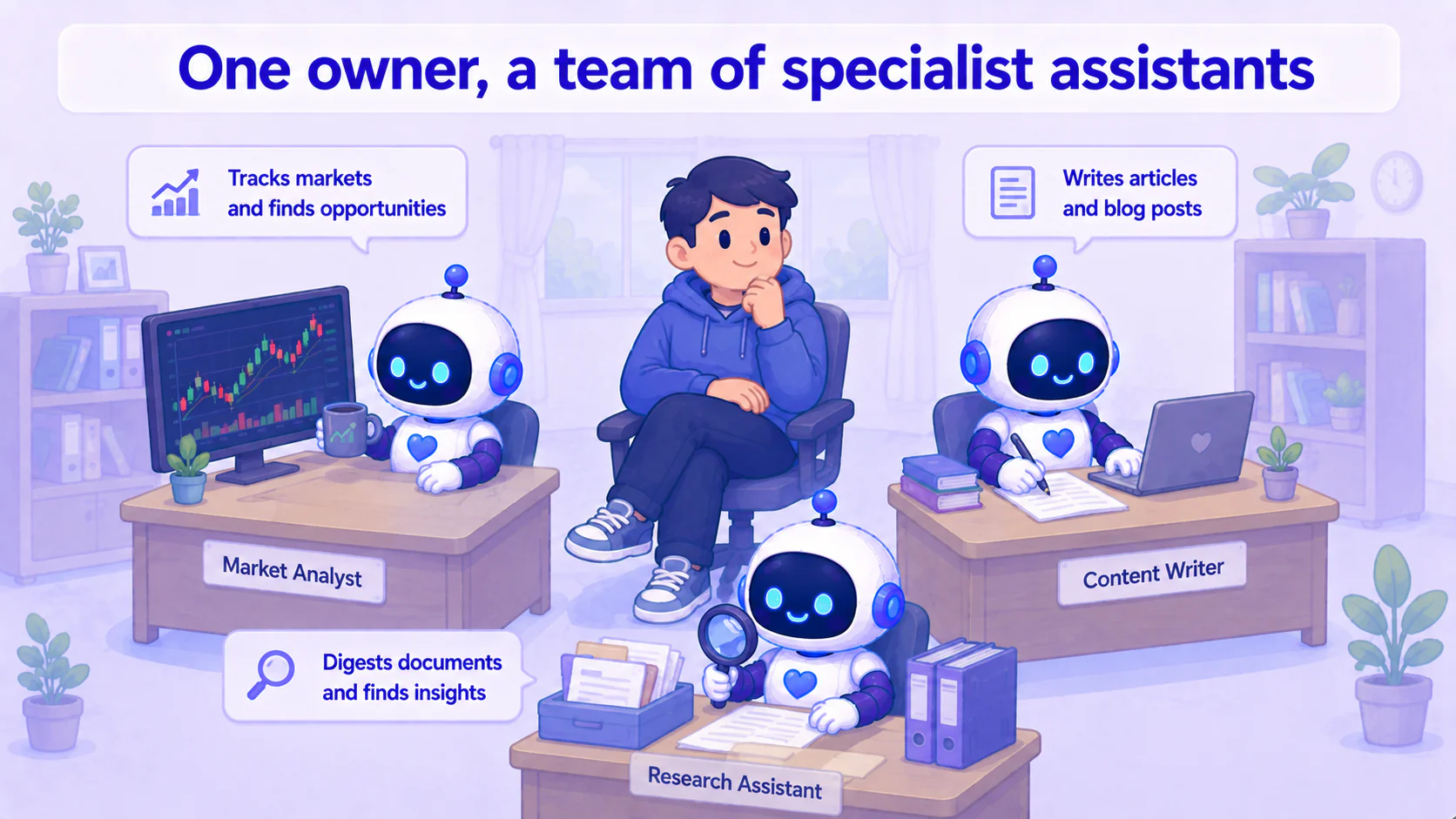
You can. And not the crude way of opening two windows or two accounts. Hermes runs several fully independent assistants on one computer — each with its own desk, its own brain, its own memory.
This post is about that: what a "separate assistant" is, why you'd split them, how, and what the ones I run actually look like.
This is the advanced track — make sure you actually need it
Let me say this up front so you don't waste effort.
The beginner series was about raising your first working assistant. For most people that's the finish line — one assistant, throw everything at it, great.
Running several is an advanced move. It solves one specific problem: you have several unrelated uses, and cramming them all into one assistant makes them fight. A stock-watching assistant wants to be calm and numbers-only; a writing assistant wants to roam free. Force both personalities into one brain and it gets confused. That's when separate assistants earn their keep.
If your one assistant is humming along fine, read this as a story and don't rush to act. Get one solid first; split only when you hit the wall.
What's a "separate assistant"? Several independent ones on the same computer
Hermes officially calls this feature a profile; in this post I'll just call them separate assistants. Picture one owner with several pets.
They live in the same house (your computer), but:
- Each has its own personality: one gentle, one quick, one sharp.
- Each remembers its own things: what one knows, the others don't.
- Each does its own work: the stock-watcher never wanders off to write, the writer never goes digging for stock data.
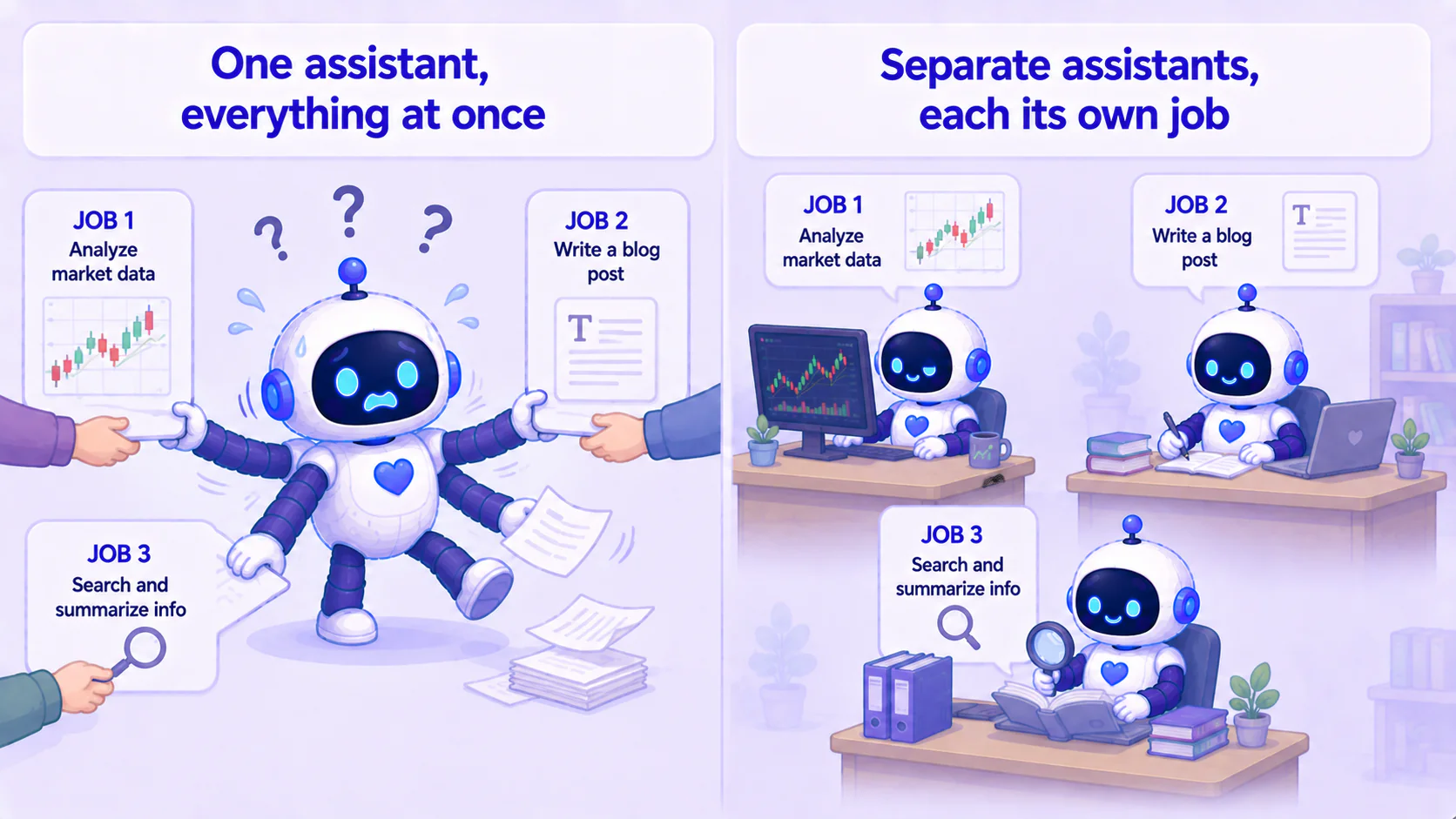
The last point is the key one — they're isolated from each other. You can tune one, feed it new memory, swap its brain, and the others don't move an inch. That's different from "one assistant you tell to watch stocks today and write tomorrow" — that's one pet yanked between two jobs, and it gets muddled. Separate assistants are two different pets, each minding its own.
Each gets a "home": its desk, drawers, and nameplate
So how is that isolation done? Each assistant gets its own folder — Hermes calls this the HERMES_HOME (literally "this assistant's home").
Picture each one having its own desk in the office. On the desk:
- Its nameplate and personality (what it's called, its temperament, how it talks) — the config.
- Its private drawer (what it remembers) — the memory.
- A note for which brain it uses (which AI model to connect to).
Separate desks, nothing gets mixed. To swap assistant A's brain, you walk to A's desk and change its note; you never touch B's desk, and B keeps running. Want a new one? Set up a new desk (create a new home), put down its nameplate, drawer, and note — and it's born.
In practice you won't dig through folders by hand — Hermes has commands to create, switch, and configure them. This post is the concept: one desk per assistant, desks kept separate, so they don't interfere. The exact commands depend on your Hermes version; follow the official docs.
Each runs its own brain, each minds its own job — why that's useful
The biggest payoff of separate desks is that each assistant can use a different brain.
Recall #3: an assistant's "brain" is the AI model behind it. On one computer you can have:
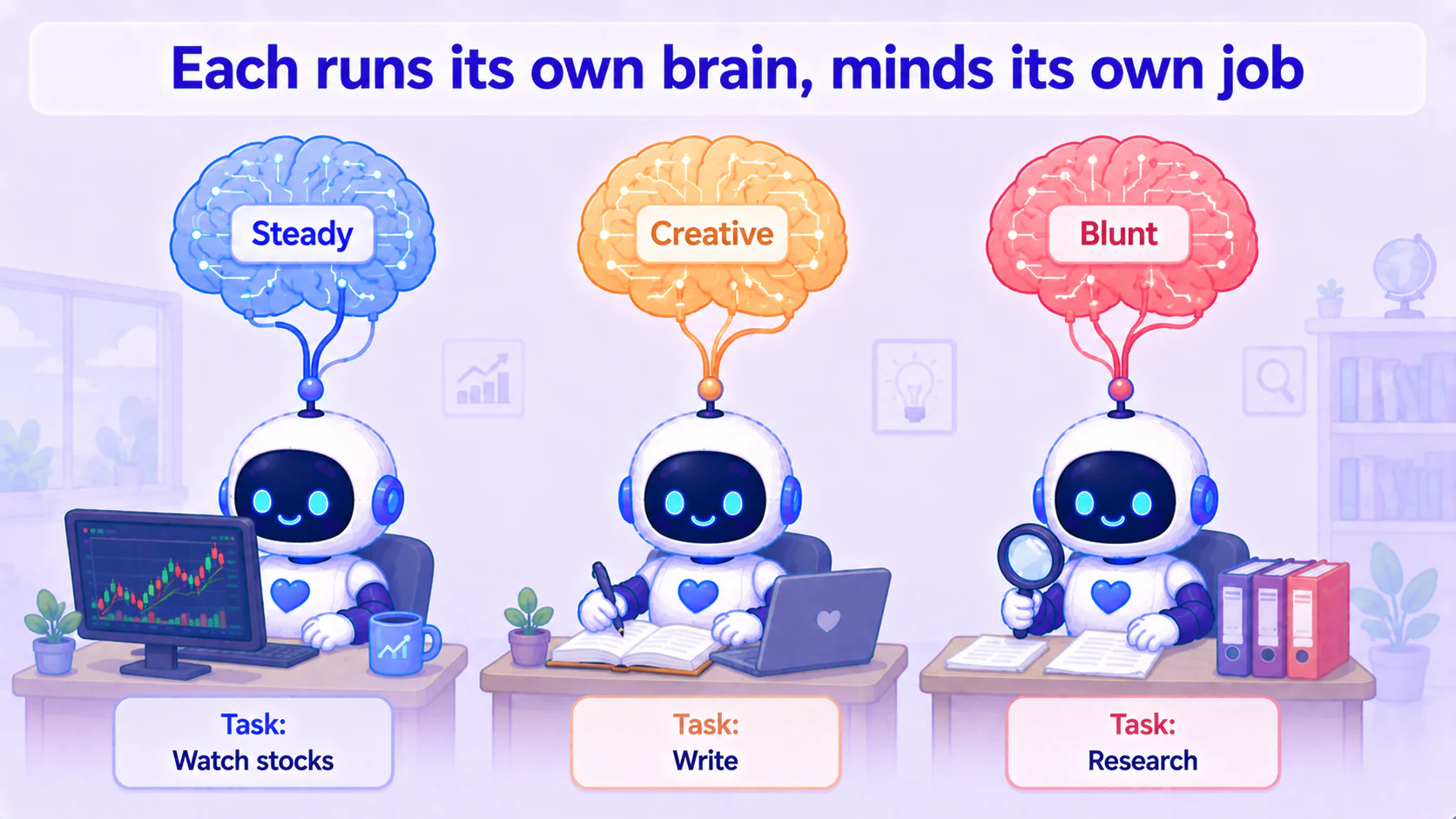
- Stock-watcher → a calm, reliable brain, ideally a free one running on your own machine.
- Writer → a brain with good prose that likes to roam.
- Researcher → a sharp brain that says the hard thing.
Swapping a brain touches only that one's note; the others are untouched. That's "each runs its own brain."
Pair that with "each minds its own job" — each assistant takes only the tasks it should and remembers only what it should — and you don't end up with one jack-of-all-trades, master of none. You get a small team of specialists. The stock-watcher gets to know your positions better; the writer gets a sharper read on your voice, because their memories never get polluted by each other's tasks.
The ones I run: my main, my creative one, my research one
Concepts are abstract, so here's what I actually run. Three:
- Main — my primary assistant, the one I reach for all day, the one I live with.
- The creative one — handles ideation and content work. Its brain is a model running on my own machine.
- The research one — the sharpest, blunt by design; I want it to poke holes in my plans and tell me the worst case straight. It runs a sharper, more candid cloud brain.
Three separate desks (homes), each remembering its own things, each on its own brain. When I tune the research one to be blunter and less wordy, the other two are completely untouched — that's the value of isolation: I can chisel away at one without breaking the other two.
One gotcha I ran into: I once wrote one assistant's note as "use some model running on my machine," but that model wasn't actually up — so it quietly switched to another one without telling me. Lesson: write the note correctly, and pin each assistant to one brain — don't set a "if this fails, try that" fallback chain, or one day it'll run on a brain you didn't expect and you'll be hunting for why. That's the tax on the advanced stuff; know it going in.
Takeaways
A separate assistant is about "isolation," not "copies"
A second assistant isn't "one more of the same" — it's one more that's different, and that doesn't interfere. Separate desks (homes) keep personality, memory, and brain apart, so touching one never hurts another. Without that isolation, you're just wearing one assistant out.
One person can be the owner of a whole team
It sounds like a lot to run a team, but it all runs on your own computer, with your own account, your data on your side. You're the sole owner — their desks, drawers, nameplates are all in your house. Raise them, tune them, retire them: your call.
Don't split for the sake of splitting
The most important one. Separate assistants solve one concrete problem: several uses fighting each other. No such problem? Don't split. Each extra one is another desk to mind and another brain to manage. Get one assistant to the point where it feels overloaded — that's the moment to split. Until then, one is plenty.
Conclusion
- A separate assistant (Hermes calls it a profile) = several independent assistants on one computer.
- Each has its own home (HERMES_HOME): its own config, memory, personality — like each having its own desk.
- Separate desks mean each runs its own brain and minds its own job; tuning one doesn't affect the others.
- I run three — main, creative, research — each a specialist, none interfering.
- ⚠️ Honest note: this is advanced, and one assistant is enough for most people; pin each one to a single brain, skip fallback chains, or it'll quietly switch brains on you.
Raising assistants is like keeping pets — one to keep you company is enough; you get a second because you genuinely need a different one, not because "more is better."
This series — AI Agent Life, from Zero:
- Part 1: AI assistant vs ChatGPT
- Part 2: What is an agent framework
- Part 3: The ChatGPT-brain + Hermes-body combo
- Part 4: Install Hermes Desktop
- Part 5: Connect Hermes to Telegram
- Part 6: Let your assistant run on its own
- Part 7: Give your AI assistant eyes and ears
- Part 8: One person, a whole team of assistants (this post)
FAQ
- What is a Hermes 'profile' (a separate assistant)?
- It's running several independent assistants on the same computer. Each has its own config, its own memory, and its own personality, and they don't interfere with each other. You can have one watch your stocks, one write articles, one do research — each doing its own thing and remembering only its own things. Hermes officially calls these 'profiles'.
- Can each assistant use a different AI model?
- Yes. Each profile's config points at its own brain — one can use a strong cloud model, another a free model running on your own machine. Swapping one doesn't touch the others.
- Do most people need a bunch of these?
- No. One assistant is plenty for most people. Multiple profiles are for when you have several unrelated uses that fight each other in one assistant, or you just want to tinker. Get one solid first; only split when one assistant genuinely feels overloaded.
Read next
- 2026-07-01[Agent 101 #15] Hermes /learn: I had a local 27B write its own reusable skill
Hermes has a /learn command that turns 'something you just did' into a reusable skill — a SKILL.md. I wired it into my own fleet: one Kanban card, a local 27B running on a modded 2080 Ti, and about 3 minutes later it handed back a clean, spec-compliant skill — plus two implementation details the docs don't spell out (slash command vs. dispatch, and where skills actually live). A plain-language walkthrough of what /learn does, how to use it, and where its limits are.
- 2026-06-22[Agent 101 #11] Assistant gone haywire? Don't blame the engine — usually it's the car that broke, not the engine
When an AI assistant loops, wanders, freezes, or answers the wrong question, your first instinct is 'this model is dumb.' But from my own debugging, eight times out of ten it's not the model — it's the ring around it (tools, config, memory). The model is the engine; that ring is the car. A car that won't move usually doesn't have a broken engine — it has a flat tire or a clogged fuel line.
- 2026-07-21[Agent 101 #16] Hermes config health check: 5 silent gotchas that make your assistant act weird
Part 11 said a haywire assistant is usually a broken car (tools, config, memory), not a dumb engine (the model). This is that checklist: a context_length set at the wrong level silently compresses early, Qwen thinking left on runs 10x slower, an MCP tool that connects but every call fails, and a sib running a different model than you think. Five real config gotchas, each with a check you can hand to your agent to run on itself, plus the fix.
- 2026-06-29[Agent 101 #14] One spec, three assistants, three Tetris games: a Hermes Kanban dispatch test
After raising a fleet of assistants, I gave them the same one-line 'make a Tetris game' spec — no details at all — one card each, and let them each write a web Tetris in a single shot. I touched zero lines of game code; I only published the result. The surprise: from that one line, the Hermes harness plus a local model I tuned myself (on a modded 2080 Ti) filled in things I never asked for — a ghost piece and wall-kick — in one shot. You can play all three.
Don't miss the next one
Subscribe, and you won't.
One-click unsubscribe anytime.