DeepSeek-V4-Flash on DGX Spark · part 7
[Local LLM] FlashMemory can't improve DeepSeek-V4-Flash's own lightning indexer — I retrained it on my exact Q2 and it still lost
❯ cat --toc
- The short version
- The setup
- Act 1 — as-is, FlashMemory's picks are indistinguishable from random
- Act 2 — retraining it on my Q2 is cheap, and it works
- Act 3 — even trained against ground truth, FM still loses to native
- The verdict: NO-GO for ds4/GB10
- The one caveat I didn't test: lookahead
- Takeaways
- Where the time went
- Reusable diagnostics
- The general principle
- Conclusion
TL;DR
FlashMemory pre-filters KV chunks before V4-Flash's native lightning indexer scores them. The paper reports ~13.5% KV footprint and up to 90% memory reduction, but on my ds4 Q2 build the shipped retriever is near-random vs native (0.566 / 0.584 / 0.664). Retraining ~160 samples fixes the distribution shift to 0.91–0.94 vs native, but dense-attention golden still says native wins: 0.930 / 0.957 / 0.956 vs retrained FM's 0.886 / 0.910 / 0.916. Verdict: NO-GO on ds4/GB10.
The short version
Picture a huge library where, for every question you ask, the librarian has to decide which shelves to pull from. FlashMemory is like hiring an outside consultant to guess in advance which shelves should be brought up from the basement, so the rest of the books can stay off the main floor and save space. Smart idea — if the consultant keeps the shelves your librarian will actually need.
The catch: V4-Flash's librarian is already excellent. At every step it already pulls only the most relevant shelves from the available set, and it learned that skill jointly with everything else it does. So the outside consultant has a hard job: if it leaves the right shelf in the basement, the good librarian never gets a chance to pick it.
I measured how good the built-in one actually is, by comparing it against the ground truth: what the model would attend to if it read every shelf. It's 93–96% right. The consultant, even after I retrained it on my exact setup, tops out at 89–92%. It's not that it's bad — it's that it would constrain a selector that's already better. So I didn't install it.
The setup
A claimed 90% KV-cache saving is the kind of number that makes you stop scrolling. FlashMemory-DS-V4 reports an average ~13.5% physical KV footprint and up to 90% memory reduction at 500K context, with quality roughly flat. On a 128GB GB10, where the KV budget is what decides how much context you can actually hold, that's worth chasing.
This is Part 7 of the DeepSeek-V4-Flash on DGX Spark series. Part 1 got the 284B model running on one box; Part 2 wired it into a daily agent. Part 6 took the architecture apart, including V4-Flash's native lightning indexer — the model's built-in sparse-attention mechanism that, in this ds4 build, selects roughly the top-512 most relevant KV chunks instead of attending to the full context. If "lightning indexer" isn't a phrase you already have loaded, read that one first, because this whole post hinges on it.
Here's the reframe that changed the question. FlashMemory is an external sparse-KV compressor: a small Neural Memory Indexer (the paper calls it Lookahead Sparse Attention) that every τ=64 decode steps predicts which compressed-attention chunks the model will attend to, fetches the critical ones into GPU memory, and leaves the rest cold. The paper is explicit about the tiering: after FlashMemory fetches a subset, the native Lightning Indexer still scores within that restricted boundary. So FlashMemory isn't adding an independent second sparse selector to V4 — it is gating the candidate set that V4's own selector can see. The bar isn't "beat dense." It's "preserve what native or golden attention would have selected while cutting memory." And that's a much higher bar, because native was trained jointly with the model.
That reframe is the whole investigation. Everything below is me measuring whether an external retriever can constrain the candidate set without throwing away chunks the model's own weights already know how to use.
One more thing before the numbers: the public FlashMemory repo is a research/demo release, not a complete production serving stack. The paper is real and the repo ships a retriever + demo (~510MB of weights, MIT), but its README says the production version depends on internal sglang + DeepSeek-V4 CSA infrastructure and cannot be released; GitHub also shows no packaged releases. The paper reports memory savings only — no speed numbers — and its own dense-recall benchmark collapses (MRCR 48% vs 76%). So I went in skeptical. But the claimed memory saving is large enough that skepticism should lead to a benchmark, not a dismissal. So I measured.
Act 1 — as-is, FlashMemory's picks are indistinguishable from random
The first test is the cheapest: take FM's retriever exactly as shipped, feed it my ds4's Q2-abliterated indexer keys, and ask which 512 chunks it wants to keep. Then compare that set against what V4's native indexer actually selected on the same input — the model's own top-512. If FM is worth anything, its picks should overlap the native picks a lot more than chance.
They don't.
| Layer | FM-vs-native overlap | Random baseline |
|---|---|---|
| L10 | 56.6% | 57.6% |
| L12 | 58.4% | 57.6% |
| L20 | 66.4% | 57.6% |
L10 and L12 are at or below the random baseline. L20 clears it by 8.8 points, and that's the best layer. This isn't "FM is a bit worse than native" — it's "FM's selection carries almost no information about what the model actually attends to."
One nuance: FM's scores aren't degenerate. They spread out — the retriever has discriminative power, it's confidently ranking chunks. It's just ranking them by the wrong relevance. Confident and wrong. The root cause isn't hard to guess: FM's retriever was trained on the original, un-quantized V4, and I'm running it on a Q2-abliterated build. The indexer keys it learned to read shifted under it. This is textbook distribution shift, and it produces exactly this signature — high-confidence, near-random selection.
So Act 1's result is not "FlashMemory is bad." It's "FlashMemory, as shipped, can't be evaluated on my model, because it's reading keys from a distribution it never saw." Which raises the obvious next question.
Act 2 — retraining it on my Q2 is cheap, and it works
If the problem is distribution shift, the fix is to show FM my distribution. The question is how expensive that is. If it needs full retraining on a cluster, FlashMemory is dead on arrival for a single-box setup. If it takes ~160 samples on the box I already have, that changes things.
It took ~160 samples.
I fine-tuned only FM's small projection weights — wq_a, wq_b, weights_proj — with a BCE loss against native's keep/drop decisions. Not the whole retriever, just the projections that map indexer keys into FM's scoring space.
| Layer | Before (as-is) | After retraining |
|---|---|---|
| L10 | 0.566 (≈ random) | 0.91 |
| L12 | 0.584 | 0.94 |
| L20 | 0.664 | 0.94 |
Train overlap hit 0.98, val 0.91–0.94 — the gap is small, so it's generalizing, not memorizing 160 samples. Two key takeaways emerge. First, Act 1's near-random result was purely distribution shift: there was no architectural reason FM couldn't match native, because once it sees Q2 keys it matches native at 0.91–0.94 in a couple hundred samples. Second, and this is the trap: at this point FlashMemory looks like a success. It went from random to 94% agreement with the model's own indexer. If I'd stopped here I'd have written the opposite post.
But 94% agreement with native isn't the goal. Agreeing with native just means "I can imitate V4's indexer." The actual question is whether FM can do better than native — and to ask that, I need a truth that isn't native.
Act 3 — even trained against ground truth, FM still loses to native
To know whether the pre-filter is safe, you have to score against the real answer, not only against native's answer. The real answer is dense attention: what the model would attend to if it computed unmasked softmax over all chunks, no sparsity at all. That's the ground truth both selectors are approximating. So I dumped real dense attention as golden and re-scored everyone against it.
200 samples, validation, keep 512 of ~800 chunks, random baseline 0.67:
| Selector | vs golden (L10) | L12 | L20 |
|---|---|---|---|
| Native indexer | 0.930 | 0.957 | 0.956 |
| FM, as-is | 0.64 | ~0.67 | 0.69 |
| FM, retrained to golden | 0.886 | 0.910 | 0.916 |
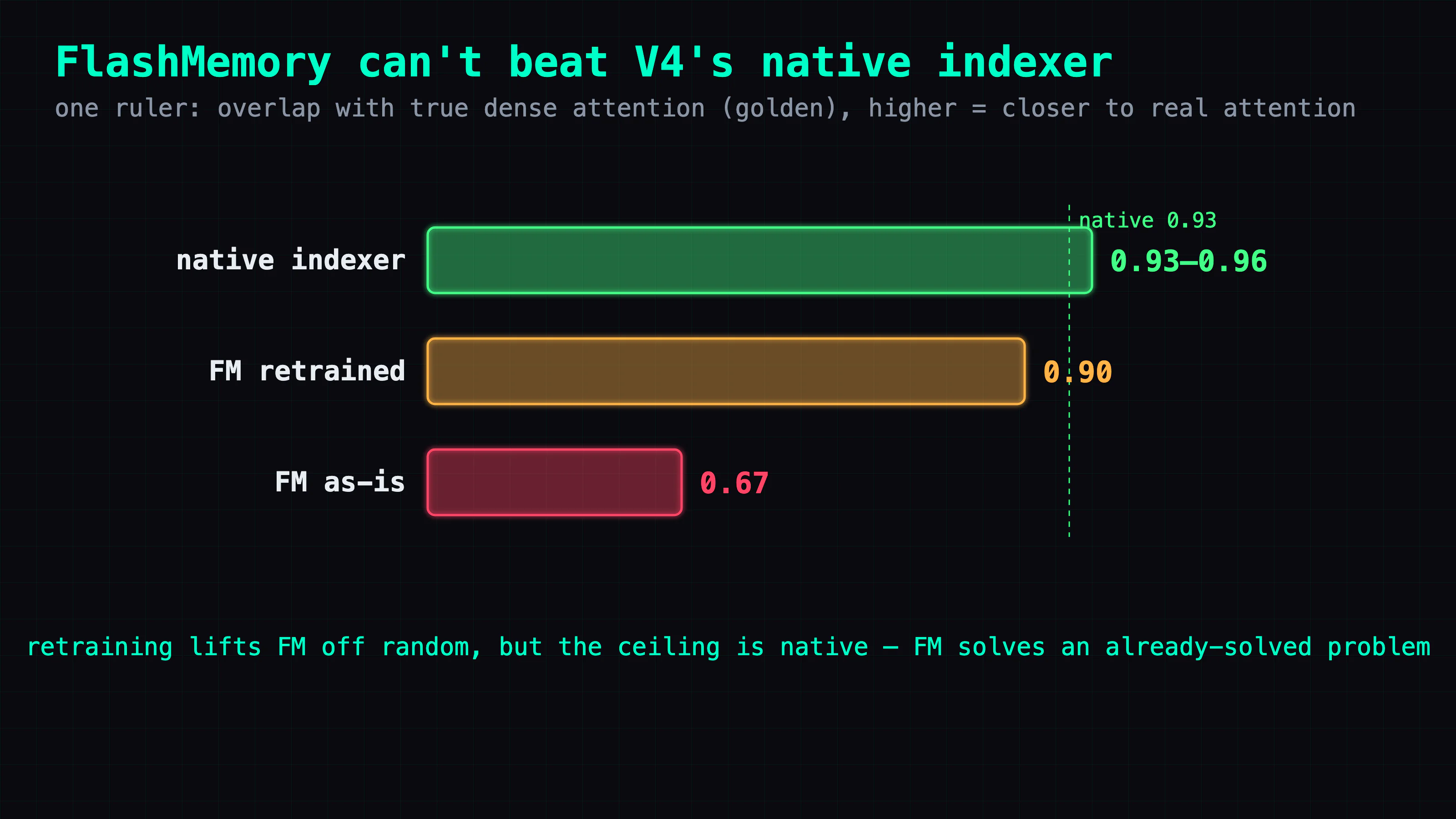
Read the top row first. V4-Flash's built-in lightning indexer tracks true dense attention at 93–96%. That's the number that ends the investigation. The model's own indexer, trained jointly with the model, is already sitting almost on top of the ground truth. There isn't much room above it.
FM as-is is ≈ random against golden too (0.64–0.69), same distribution-shift pattern. Trained against ground truth, FM climbs from near-random to 0.886 / 0.910 / 0.916 — a real improvement, retraining genuinely helps. But it lands under native on all three layers. 0.886 vs 0.930. 0.910 vs 0.957. 0.916 vs 0.956. Retrained FM, trained directly on the golden target, still can't reach what native does natively.
The verdict: NO-GO for ds4/GB10
FlashMemory is a NO-GO on this stack, and the reason is clean enough to state in one sentence: V4-Flash's lightning indexer is jointly trained with the model and already tracks true attention at 93–96%, so an external pre-filter — even one retrained on my exact Q2 against the golden target — can't preserve enough of the right chunks to improve it.
This isn't a knock on FlashMemory as a technique. It's a scope statement for this ds4/GB10 stack. FlashMemory is a real prefetch/offload design for ultra-long context, and the paper's memory result is impressive. But V4-Flash already solved sparse selection internally. Installing FlashMemory here would mean constraining a 93–96% native selector with an 89–92% retrained pre-filter and calling it an upgrade.
The one caveat I didn't test: lookahead
There is one caveat to address. My golden was current-token attention — what the model attends to right now. FM's actual design point is lookahead: it predicts the next 64 tokens' attention, not the current token's. Native is per-token. So I benchmarked FM slightly off its home turf.
Could FM close the gap on a lookahead golden? In theory, yes — that's the one axis where its design has an edge native doesn't explicitly optimize for. But I doubt it, for a concrete reason: FM already trails native by 4–5 points on the current-token target it was retrained on. A 4–5 point comeback purely from the lookahead framing, enough to overtake a 93–96% native selector, is a lot to ask. And measuring a lookahead golden is much more expensive — you have to dump dense attention over a 64-token horizon per sample. Given the current-token result, I don't think that extra compute changes the verdict. If someone wants to prove me wrong, that's the experiment.
Takeaways
Where the time went
Not in retraining — retraining uses ~160 samples and finishes fast. It went into Act 2's trap. After FM hit 94% agreement with native I genuinely thought I had a positive result, and I nearly wrote it up as one. I spent that extra hour building the golden attention baseline to check whether "agrees with native" and "beats native" were actually the same thing. They weren't, and the difference is the entire finding. Matching the model is not beating the model.
Reusable diagnostics
Before you bolt an external sparse-KV scheme onto a model, run one measurement first: the model's native selector vs true dense attention. Dump unmasked softmax as golden, score the built-in indexer against it. That single number tells you the ceiling. If native is at 93–96%, there's a 4–7 point gap for any external scheme to fit into, and it has to be perfect to fill it — which no distribution-shifted retriever will be. If native were at, say, 70%, the story might have ended differently. Without dumping the ground truth, you do not know which scenario you are in — and dumping it is cheap. Do it before you evaluate anything external.
The general principle
Measure how well the model already solves the problem before you try to solve it externally. FlashMemory is a good technique aimed at a real problem — for the wrong model. V4-Flash already has a native, jointly-trained sparse selector that's near-optimal, so an external one is solving an already-solved problem, and solving it worse. The failure wasn't in FlashMemory's design or the retrain. The mistake was assuming the problem was still open.
Conclusion
- Check for a native indexer first. If your model already does sparse KV selection (V4-Flash's lightning indexer does), an external compressor has to preserve the native/golden winning set while cutting memory. That's a much higher bar than just adding sparsity to a dense baseline.
- Dump the golden. Unmasked dense attention is the ground truth. Score the native selector against it — for V4-Flash that's 93–96%, near the ceiling.
- Don't confuse "matches native" with "beats native." Retrained FM hit 94% agreement with native and still lost to native against golden (89–92% vs 93–96%). Agreement is not improvement.
- Distribution shift looks like incapacity but isn't. As-is FM was ≈ random on my Q2 purely because it was trained on un-quantized V4; ~160 samples fixed the shift. If you're evaluating a retriever on a quantization it never saw, retrain the projections before you judge it.
- NO-GO for ds4/GB10. FlashMemory can save memory, but on this stack it constrains a native selector that is already better. The only untested door is a lookahead golden, and a 4–5 point comeback through it is unlikely.
Also in this series: Part 1 — Running a 284B on a 128GB box, then blaming the wrong thing for broken tool calls · Part 2 — Running a 15 tok/s 284B as your daily agent brain: the settings that make it bearable · Part 6 — Inside V4-Flash's architecture and its lightning indexer
FAQ
- Does DeepSeek-V4-Flash need an external KV compressor like FlashMemory?
- No for this stack. V4-Flash already has a native lightning indexer — a built-in sparse-attention mechanism that selects roughly the top-512 most relevant KV chunks per step in this ds4 build. FlashMemory would pre-filter the candidate set that native can score, so it has to preserve the chunks native or golden attention would need. In my tests it doesn't.
- Why did FlashMemory pick almost randomly on your Q2 build?
- Distribution shift. FlashMemory's retriever was trained on the original, un-quantized DeepSeek-V4; I ran it on a Q2-abliterated build. Its scores were still confident and discriminative — it just ranked chunks by the wrong relevance. Head-to-head overlap with the native top-512 was 56.6% / 58.4% / 66.4% (L10/L12/L20) against a 57.6% random baseline. Retraining its projection weights on ~160 Q2 samples fixed the shift entirely (overlap jumped to 0.91–0.94), so it was never an architectural limit.
- How close is V4-Flash's native lightning indexer to true attention?
- 93–96%. I dumped real dense attention (unmasked softmax over all chunks, no sparsity) as golden, and scored the native indexer against it: 0.930 / 0.957 / 0.956 at layers 10 / 12 / 20. Because it was trained jointly with the model, it sits almost on top of the ground truth — which is exactly why an external, distribution-shifted retriever can't overtake it.
- Is FlashMemory a bad technique?
- No — it is a real prefetch/offload design for ultra-long context. The problem is that on V4-Flash it constrains a native selector that is already very good. Retrained toward the golden target, FlashMemory reached 0.886 / 0.910 / 0.916 — real improvement, still under native's 0.930 / 0.957 / 0.956.
Read next
- 2026-07-07[Local LLM] Why a 284B fits a 128GB GB10 at long context: DeepSeek-V4-Flash attacks the KV cache, not the parameter count
DeepSeek-V4-Flash is a 284B MoE that stays fast at long context on a 128GB GB10 because its hybrid CSA/HCA attention and lightning indexer shrink the KV cache to ~871MiB at 64K and read only a few hundred compressed rows per step. What I found reading ds4's code and DeepSeek's V4 paper.
- 2026-07-05[Local LLM] My 284B agent quietly stopped reusing its KV cache — the ds4 evict storm that re-paid prefill every turn
A month after wiring DeepSeek-V4-Flash into a daily agent, it felt slow again. Two log lines explained it: the disk-KV cache was evicting live prefixes (hits=0), and tool-call turns never saved a checkpoint — so common=268 out of 14209 and every turn re-paid full prefill. The fix: 256G KV budget + PR #489.
- 2026-06-12[Local LLM] Running a 15 tok/s 284B as your daily agent brain — the settings that make it bearable
A 284B model at 15 tok/s, wired into a daily agent. Two sets of settings make it comfortable — server-side and agent-framework-side. --no-mmap cuts cold start to 57s, the KV disk cache halves prefill, and one missing context_length will crash the whole session.
- 2026-07-06[Local LLM] Depth-1 MTP on V4-Flash: +9% on agent turns, −4% on prose — route speculative decode by workload
Depth-1 MTP speculative decode on DeepSeek-V4-Flash is lossless but workload-dependent on a GB10: +9.4% on agent turns and +6.5% on code, −3.6% on prose and −3.7% on Chinese chat. The sign follows the acceptance rate because decode here is verify-bound (108ms verify vs 4ms draft). It's not a global faster switch — route it by workload.
Don't miss the next one
Subscribe, and you won't.
One-click unsubscribe anytime.