DeepSeek-V4-Flash on DGX Spark · part 1
[Local LLM] My first Q2 model looked broken on a 128GB box — the real culprit was a parser that couldn't read DSML, not the quantization
❯ cat --toc
- The short version
- The setup
- Phase 0: I didn't have to write five CUDA ops — the community already did
- First GB10 numbers, stuck behind a stale nvcc
- 15.6 tok/s, and six configs all pinned to the same number
- The tool-call detective story: I blamed 2-bit
- Shipping it: wiring it into my agent
- Takeaways
- Where the time actually went
- Debugging takeaways
- The one-liner
- TL;DR
TL;DR
DeepSeek-V4-Flash is a 284B model. I got it onto a single 128GB DGX Spark (GB10) with antirez's hand-written ds4 engine and an asymmetric Q2 GGUF (~80GB), decoding at 15.3–15.6 tok/s. The interesting part wasn't the number — it was a conclusion I got wrong. I thought the model was "faking tool calls and making up results" because 2-bit was too lossy. The real culprit: the runtime had no DSML parser. DeepSeek-V4 calls tools in DSML (XML-like), not JSON. The model emitted it correctly; nothing parsed it. Swap engines and 2-bit calls tools just fine.
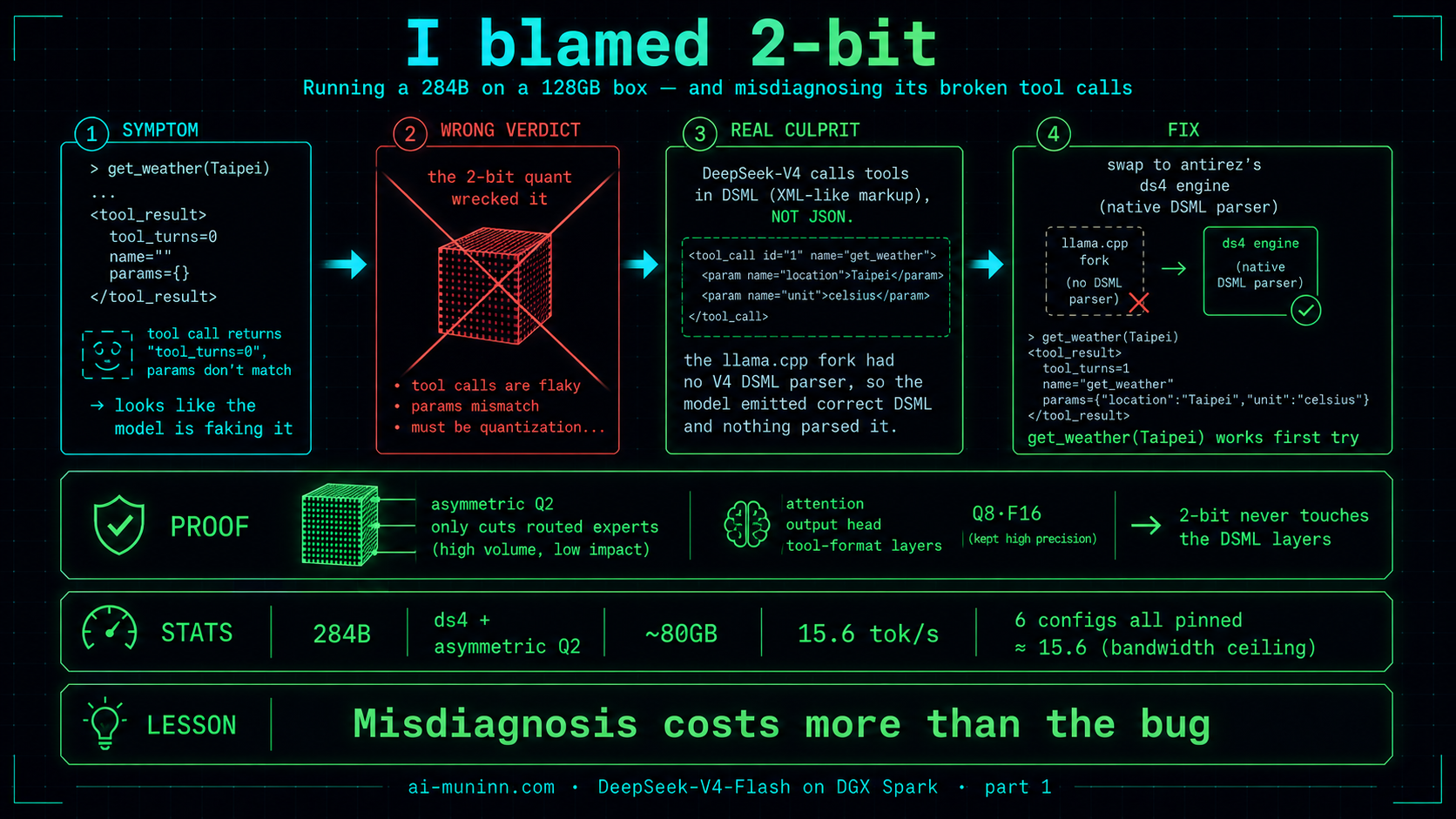
The whole post in one image
The short version
DeepSeek-V4-Flash is a 284B-parameter model — the kind of thing that normally lives in a server rack. I only have a desktop box: a DGX Spark with 128GB of unified memory. Quantization (squeezing every weight to fewer bits) gets it small enough to fit, and the result is a genuinely capable model running entirely on my desk. This is one evening: getting it running, benchmarking it, and wiring it into my daily agent. The detour worth reading is the part where I decided the model "couldn't use tools" — and was wrong about why.
The setup
Spec sheets lie. You see "128GB unified memory" and assume you can finally run big models; you actually run one and learn that "fits" and "runs well" are two different things.
This is part 1 of the DeepSeek-V4-Flash on DGX Spark series. It started one tired night with "is DSv4 even worth squeezing onto a GB10?" and ended with the thing wired into production. This post covers whether it runs and the tool-call bug I misdiagnosed. Part 2 covers the memory and context engineering to make it a daily driver; Part 3 covers why a 284B model crushed to 2-bit still holds up.
Phase 0: I didn't have to write five CUDA ops — the community already did
My first instinct was "this needs hand-written kernels." DeepSeek-V4 has a compressed KV cache and sparse routing; not every runtime can load it.
Turned out I didn't have to write any of it:
- antirez (yes, the Redis guy) wrote an engine specifically for DeepSeek-V4-Flash, called ds4, with a CUDA backend that natively understands DSv4's tool format.
- huihui already shipped an abliterated (uncensored) DSv4 GGUF in the asymmetric Q2 layout ds4 wants.
The hardest part — porting a frontier architecture to a single card and squeezing it to fit — was already done. My only job was to compile it, run it, and troubleshoot the rough edges. That's the value of a Phase 0 pass: survey before you build, and you often find the wheel already exists.
First GB10 numbers, stuck behind a stale nvcc
The build command is clean:
git clone https://github.com/antirez/ds4 && cd ds4
make cuda-spark            # don't pass -arch yourself; ds4 says this is fastest
You don't quantize anything yourself — ds4 ships download_model.sh. On my 128GB box, q2-imatrix:
./download_model.sh q2-imatrix    # 96/128GB boxes; lands in ./gguf/ and points ./ds4flash.gguf at it
./download_model.sh mtp           # MTP draft, if you want speculative decoding
There are two builds, and the speed numbers below cover both:
- Stock: antirez's own q2-imatrix, ~80GB, from antirez/deepseek-v4-gguf (that's what
download_model.sh q2-imatrixabove pulls). - Abliterated (uncensored): huihui's build — same asymmetric Q2 layout, uncensored. A separate download from huihui-ai/Huihui-DeepSeek-V4-Flash-abliterated-ds4-GGUF (
Huihui-DeepSeek-V4-Flash-BF16-abliterated-ds4-Q2.gguf, 86.7GB); just point-mat that file. This is the one I run daily.
The first build hit a wall. A stale /usr/bin/nvcc (12.0) was shadowing the 13.2 I'd installed, and the compile died on math-vector.h __SVFloat32_t undefined. Make sure which nvcc resolves to 13.2, not the stale 12.0. Then starting the server hit a second one: the binary built by make cuda-spark (nvcc 13.2) on the stock 13.0 driver throws the provided PTX was compiled with an unsupported toolchain.
The fix is cuda-compat-13-2 (NVIDIA's official forward-compat — one package, doesn't touch the kernel driver, zero reflash risk), with the right env on launch:
sudo apt install cuda-compat-13-2          # just this package, no driver changes
LD_LIBRARY_PATH=/usr/local/cuda-13.2/compat ./ds4-server --cuda \
  -m ./ds4flash.gguf --ctx 131072 --power 100 --warm-weights \
  --host 0.0.0.0 --port 8000

# ds4 has no /health route (returns 404); watch the log for "listening on", or hit /v1/models:
curl -s http://localhost:8000/v1/models
This trick works for anything built with a 13.2+ toolchain that has to run on the stock 580 driver — no risky driver upgrade (on DGX Spark a driver upgrade can boot-loop you into a USB rescue).
One easy gotcha: --power. ds4 already defaults to 100 (full speed), so you don't normally set it — but some community recipes copy --power 75, which costs you 25% (11.5 vs 15.3 tok/s). Make sure you're at 100. --warm-weights loads the weights into the GPU before serving, so the first request doesn't eat a cold-start spike.
15.6 tok/s, and six configs all pinned to the same number
Once it ran, I swept every knob. The result is a little funny — nothing moved the needle:
| Config | decode tok/s |
|---|---|
| stock Q2 | 15.56 |
| stock + MTP draft 1 | 15.58 |
| stock + MTP draft 2 | 14.48 |
| huihui abliterated Q2 | 15.3 |
| huihui + MTP draft 1 | 15.63 |
| huihui + MTP draft 2 | 14.44 |
Six configs — stock, abliterated, speculative on, speculative off — all parked around 15.6. On ds4, that's the ceiling: GB10's 273 GB/s feeding 80GB of weights only lets you emit so many tokens per second. (Strictly, it's ds4's ceiling — a different engine with better kernels moves the number, which I cover with the Atlas example in the Qwen3.5-122B post.)
Two results stood out. First, speculative decoding (MTP) doesn't pay off here. Draft 1 is roughly break-even; draft 2 actually drops to 14.5 — and that slowdown is the proof the mechanism is real (you only pay overhead if it's actually engaged), which makes draft 1's flat result a genuine break-even, not a no-op. On a bandwidth-bound box, the extra bandwidth speculation burns is about what it earns back.
Second, abliteration doesn't cost speed here. Stock is only ~1.7% faster than abliterated (noise). I'd measured abliteration costing -50% chat throughput on Gemma; what's the difference? The bottleneck. You pay the abliteration tax when you're compute-bound, not when you're bandwidth-bound.
The tool-call detective story: I blamed 2-bit
This is the part worth writing about.
Rewind a bit: before I switched to ds4, I first tried tool use on llama.cpp, running that Q2 DSv4 directly. I sent it a weather-tool request and got back something that looked like a tool call but wasn't really one — tool_turns=0, parameters that didn't line up, like it was acting out a result. I jumped to the obvious conclusion: the 2-bit quant had wrecked it so badly it couldn't even emit valid tool calls.
That conclusion was half wrong. The direction was right (the output wasn't being treated as a tool call); the attribution was wrong (not 2-bit).
The truth: DeepSeek-V4 doesn't call tools in JSON/ChatML — it uses DSML, an XML-like markup that looks like this:
<|DSML|tool_calls><|DSML|invoke name="get_weather">
<|DSML|parameter name="city" string="true">Taipei</|DSML|parameter>
</|DSML|invoke></|DSML|tool_calls>
The llama.cpp fork I was running had no V4 DSML parser (upstream only knows V3.2's function_calls, not V4's tool_calls; the relevant PR was closed unmerged). The model emitted correct DSML — nothing parsed it, so it became plain text → tool_turns=0 → looks like the model faking a call.
The proof is in the quant table. huihui's asymmetric Q2 allocates precision like this:
| Layer | Precision |
|---|---|
| routed ffn gate/up experts | IQ2_XXS |
| routed ffn down experts | Q2_K |
| shared experts / attention / output head | Q8_0 |
| embedding / router / indexer | F16 |
Everything at 2-bit is a routed expert — huge in volume, but each only touching a tiny slice of tokens. Everything tied to tool format, routing, and attention stays at Q8/F16. 2-bit never touches the layers that emit DSML.
Swap in the ds4 engine (which renders and parses DSML natively) and tool calls just work: get_weather(Taipei), structured tool_calls, first try. The takeaway: I blamed 2-bit, but the real culprit was a runtime with no DSML parser. Put it on the right engine and 2-bit uses tools fine.
Shipping it: wiring it into my agent
The last step was wiring it into the agent I use every day. The serve command is the one above; the client uses model=deepseek-chat for non-thinking mode — partly to dodge a known bug where thinking mode swallows the DSML, partly because everyday chat is snappier that way.
ds4 has one more thing I ended up loving: a KV disk cache. It writes computed prefix KV to NVMe, so the next conversation with the same opening loads straight off disk instead of recomputing. That's the load-bearing piece for "frontier model as a daily driver," so it gets its own treatment in Part 2.
Takeaways
Where the time actually went
Not the build — debugging the tool calls. I stared at "faking a tool call" output and my brain auto-filled "2-bit is too lossy," and I almost wrote that as the conclusion. What actually cracked it was reading DeepSeek-V4's encoding docs, finding DSML, and realizing the problem lived in the runtime, not the model. I jumped from an output symptom straight to a precision verdict and skipped the layer in between: did the runtime even parse this format?
Debugging takeaways
When a model "talks but can't use tools," don't reach for precision first. Check the wire format: what does this model use for tool calls, and does your runtime know it? DSML, function_calls, and OpenAI tool_calls are different wire formats — a parser mismatch shows up as "the model can't use tools," even when the model emitted everything correctly.
The one-liner
Misdiagnosis costs more than the bug. A "2-bit is too lossy" verdict sends you swapping models, raising precision, and burning download bandwidth; a "runtime is missing a parser" verdict just swaps engines. Before you call the model dumb, verify that every layer of the toolchain actually understands its output.
TL;DR
- DeepSeek-V4-Flash (284B) runs on a single GB10: ds4 engine + asymmetric Q2 (~80GB), 15.3–15.6 tok/s.
- The speed is a bandwidth ceiling: six configs converge on 15.6, MTP doesn't pay off under bandwidth limits, abliteration costs no speed.
- The "acting" tool calls were a misattribution to 2-bit: the real culprit was a runtime with no DSML parser. On ds4, tool calls work.
- Daily-driver details (KV disk cache, context engineering) are in Part 2; the Q2 quality argument is in Part 3.
Also in this series: Part 2 — Running a 15 tok/s 284B as a daily agent brain: the settings that make it comfortable · Part 3 — Weights win: a 284B crushed to 2-bit still beats the small model that fits
FAQ
- Can DeepSeek-V4-Flash run on a single DGX Spark (GB10)?
- Yes, with antirez's purpose-built ds4 engine and an asymmetric Q2 GGUF (routed experts at IQ2_XXS/Q2_K, attention and output kept at Q8/F16), ~80GB total. It decodes at ~15.3–15.6 tok/s on GB10. Upstream llama.cpp won't load it — no V4 architecture loader — and vLLM only takes FP4/FP8 safetensors that don't fit on one box.
- Why does DeepSeek-V4-Flash look like it can't use tools at first?
- Its tool calls use DSML (XML-like markup), not JSON. The llama.cpp fork I first ran had no V4 DSML parser, so the model emitted correct DSML but the runtime treated it as plain text — which looks exactly like faking a tool call and making up the result. Swap in an engine with a DSML parser and tool calls work. It's not the 2-bit quantization.
- Does Q2 quantization make the model dumb?
- Depends how you quantize. DeepSeek-V4-Flash uses asymmetric Q2 — only the routed experts (huge in volume, but each handling a tiny slice of tokens) drop to 2-bit; the quality-critical layers (attention, shared experts, output head) stay at Q8/F16. I ran it as a daily agent for ~30 hours / 280 turns with zero degradation.
- How fast can a 100B+ model run on GB10?
- Depends on the engine. DeepSeek-V4-Flash does ~15.6 tok/s on ds4, bottlenecked by GB10's 273 GB/s feeding tens of GB of weights. But half of that 13–17 tok/s band is immature kernels, not pure bandwidth physics — an engine with native sm_121 kernels can more than double it. For interactive speed, pick a small-active ~30B MoE (~67 tok/s on NVFP4).
Read next
- 2026-06-12[Local LLM] Weights win: a 284B crushed to 2-bit still beats the small model that fits
DeepSeek-V4-Flash (284B) only fits a 128GB box at asymmetric Q2 (~80GB). Sounds like suicide quantization — but it's surgical: only the layers that barely affect quality get cut. As a daily agent it ran 280 turns with zero degradation. Big enough weights survive 2-bit.
- 2026-07-09[Local LLM] FlashMemory can't improve DeepSeek-V4-Flash's own lightning indexer — I retrained it on my exact Q2 and it still lost
V4-Flash already ships a native lightning indexer tracking true attention at 93–96%. FlashMemory pre-filters candidate chunks, but it makes near-random selections on my Q2 and reaches only 89–92% when retrained — still a NO-GO on GB10.
- 2026-07-07[Local LLM] Why a 284B fits a 128GB GB10 at long context: DeepSeek-V4-Flash attacks the KV cache, not the parameter count
DeepSeek-V4-Flash is a 284B MoE that stays fast at long context on a 128GB GB10 because its hybrid CSA/HCA attention and lightning indexer shrink the KV cache to ~871MiB at 64K and read only a few hundred compressed rows per step. What I found reading ds4's code and DeepSeek's V4 paper.
- 2026-07-06[Local LLM] Depth-1 MTP on V4-Flash: +9% on agent turns, −4% on prose — route speculative decode by workload
Depth-1 MTP speculative decode on DeepSeek-V4-Flash is lossless but workload-dependent on a GB10: +9.4% on agent turns and +6.5% on code, −3.6% on prose and −3.7% on Chinese chat. The sign follows the acceptance rate because decode here is verify-bound (108ms verify vs 4ms draft). It's not a global faster switch — route it by workload.
Don't miss the next one
Subscribe, and you won't.
One-click unsubscribe anytime.